[Asters: The Genera Canadanthus, Eucephalus, Eurybia, Oreostemma and Symphyotrichum Found East of the Cascade Mountains of Oregon and Washington]
Few-flowered Aster, Great Northern Aster, Tall Northern Aster, Giant Mountain Aster
Canadanthus modestus
Synonyms: Aster major, Aster modestus, Aster modestus var. major, Aster sayianus, Aster unalaschensis, Aster unalaschensis var. major, Weberaster modestus
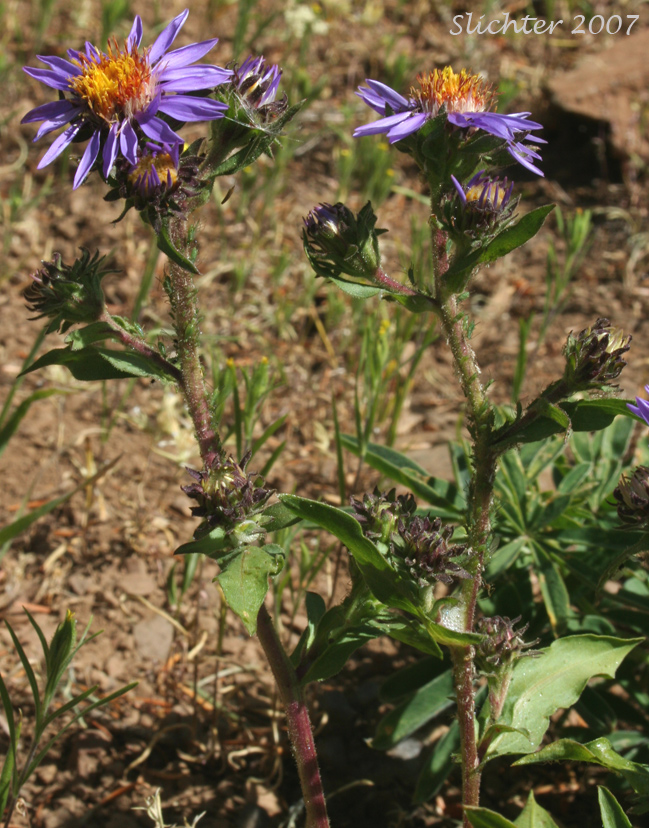
The photo above shows great northern aster as seen in meadows between Saddle Creek Campgound and Hat Point in the Hells Canyon National Recreation Area.........July 11, 2007.
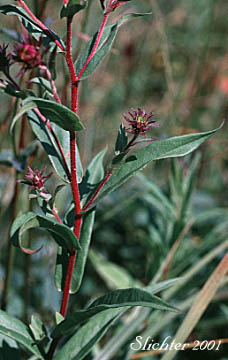 Photo at right
of great northern aster from Multorpor Fen, Mt. Hood N.F..........August 11,
2001. Note the reddish, glandular stems which are bent at the nodes, giving
the stem a somewhat zig zag appearance.
Photo at right
of great northern aster from Multorpor Fen, Mt. Hood N.F..........August 11,
2001. Note the reddish, glandular stems which are bent at the nodes, giving
the stem a somewhat zig zag appearance.
Characteristics:
The great northern aster is a pretty perennial wildflower with one to several
erect stems from 30-100 cm high arising from creeping rhizomes. The herbage
is glandular above on the leaves and stems and may have some hairs on the stems
too. The lanceolate leaves are linear-lanceolate in shape with sessile bases
which may be clasping and entire to slightly serrate margins. The leaves are
thin in cross-section and range from 5-13 cm long and 1-4 cm wide. The lower
leaves are often deciduous or withered by flowering time.
The one to many flower heads are arranged in a leafy short cyme. The heads
are 2-3 cm wide with 20-45 purple to violet rays from 8-15 mm long surrounding
a yellowish central disk. The involucre is glandular
and measures from 7-11 mm high. The involucre consists of 2-3 rows of bracts
with pointed tips. The bracts are often purplish in color and many may
be somewhat leafy in appearance.
Habitat
The great northern aster may be found in moist woodlands and mountain meadows,
and is common along streams in such habitats.
Range:
Great northern aster is found from Alaska south to Washington and Oregon
and eastward to Alberta, Montana, and Idaho. It is found further east in northern
Minnesota and Ontario.
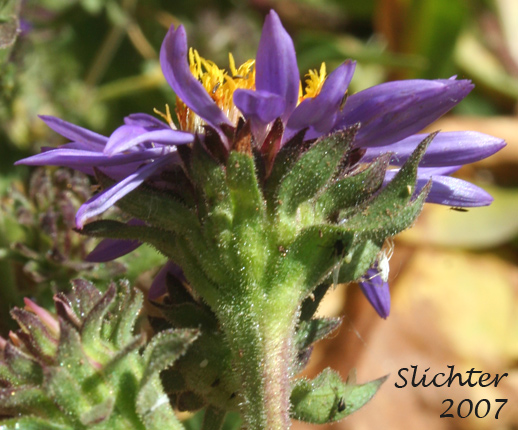
The photo above shows a close-up of the gland-covered, leafy involucral bracts of great northern aster as seen in meadows between Saddle Creek Campgound and Hat Point in the Hells Canyon National Recreation Area.........July 11, 2007.
 -
-  -
- 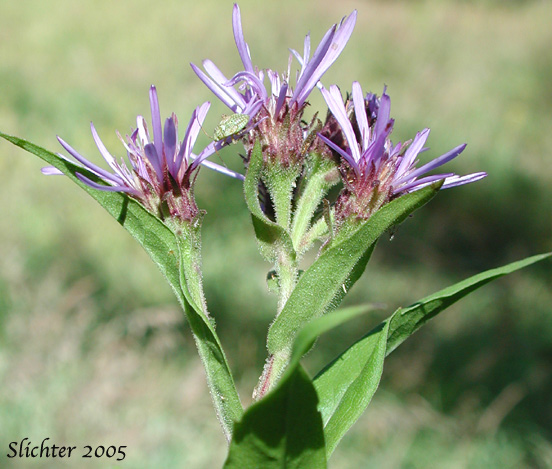
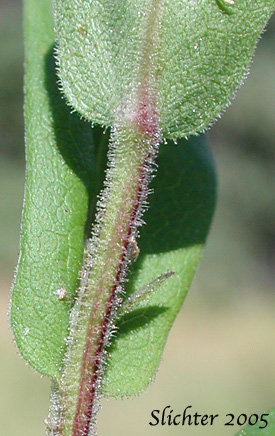
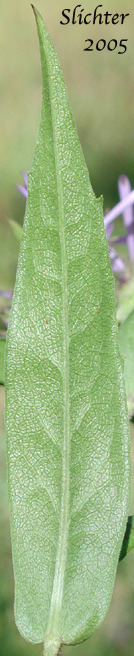
Close-up photos of the the long, lanceolate leaf blade and gland-tipped hairs on the petioles and lower leaf surface of great norther aster with its sessile base..........August 25, 2005.
Also shown is a close-up of the inflorescence of great northern aster as taken at the same location as the coordinates at the top of the page........August 25, 2005. This species may also be easily seen at the same time along Road #23 at its junction with Road #8810. Note the purplish tinge to the involucral bracts.
 -
- 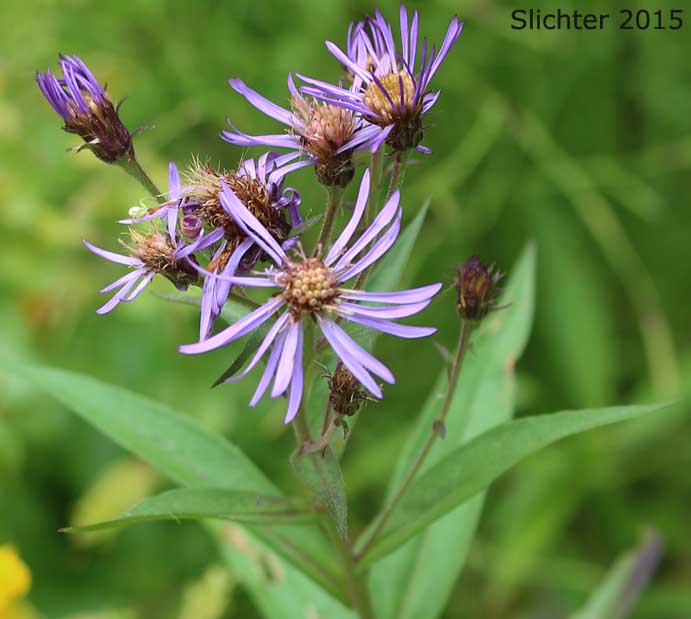
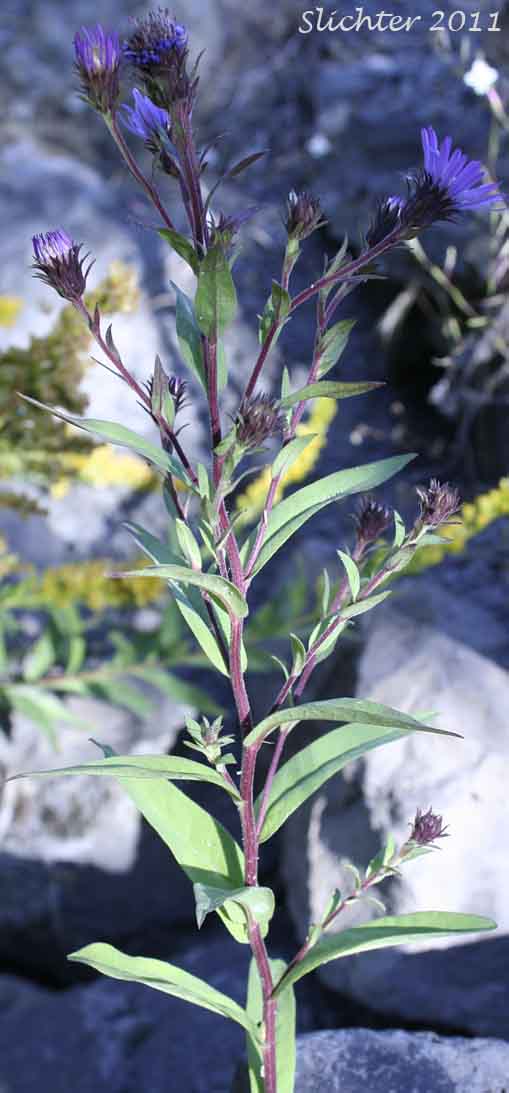
The photo above shows the long, lanceolate leaf blade of great norther aster with its sessile base as seen where Big Creek crosses FS Road #16, Malheur National Forest .........August 20, 2011. The photo at right shows northern aster as seen in wetlands atLost Lake Fen, Okanogan National Forest..........July 12, 2015.
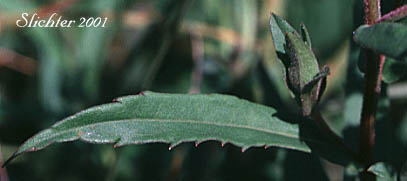
A stem leaf of great northern aster. Note the serrated margins of the blade.
Paul Slichter