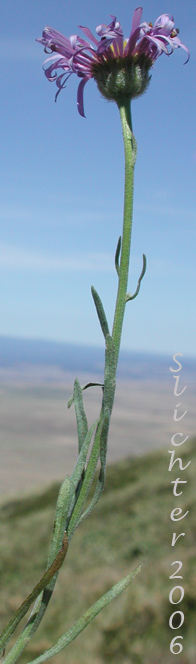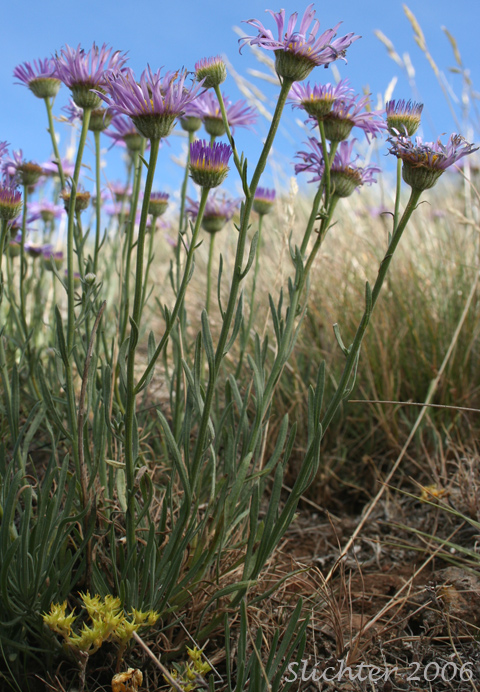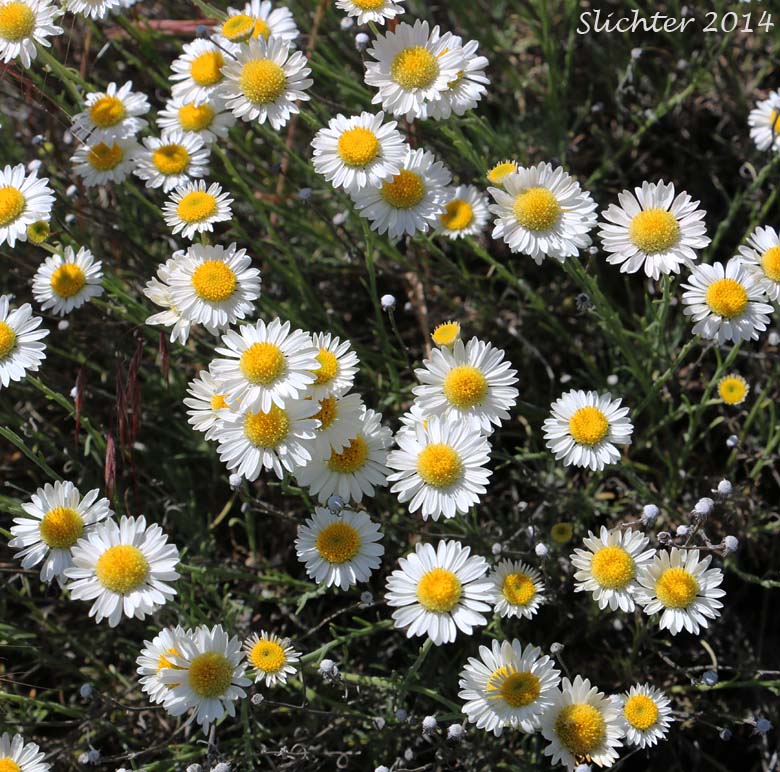
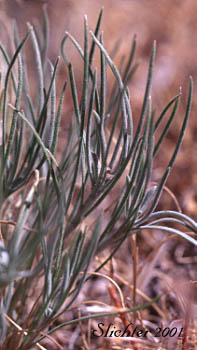
 The photo at right shows the distinctive thin leaves of thread-leaved daisy from the mouth of the Deschutes River...........September 3, 2000.
Thread-leaved daisy or fleabane is an attractive perennial with many erect to spreading stems and leaves, the stems arising from 10-150 cm high. The herbage of the stems and leaves is covered with a dense layer of grayish, straight hairs which lay flat against the stem or leaves, all pointing in the same direction. The leaves are found both at the base of the plant as well as on the stems. They are linear or threadlike in shape, ranging from 1-8 cm long and 0.3-3 mm wide.
The inflorescence consists of one to several flower heads, each at the end of a branch off the main stem. The involucre is 4-6 mm high and is densely haired with appressed, straight hairs and may also be glandular. The many ray flowers are each 3-13 mm long and 1-2 mm wide. They are blue, pink or white in color and surround the yellow central disk. Variety filifolius has several flower heads, each with 15-50 (a maximum of 75) rays while variety robustior has solitary heads with 50-125 rays.
An attractive plant, thread-leaved daisy would probably make an excellent and colorful addition to a dry prairie or rock garden. It is primarily an early bloomer, but the webmaster has seen some populations along the lower Deschutes River which bloom until late September.
Thread-leaved daisy may be found in dry place in the plains and foothills. It is often found in association with sagebrush.
Thread-leaved daisy may be found east of the Cascade crest from southern British Columbia south to northern California and east to northwestern Montana and south to Wyoming and Nevada. It is common through much of eastern Washington and eastern Oregon as well as on the Snake River plains of Idaho.
In the Columbia River Gorge, yellow desert daisy is found between the elevations of 100'-3000' from Catherine Creek east to Biggs, OR and points east in the Gorge.