[Phloxes: The Genus Phlox in the Columbia River Gorge of Oregon and Washington]
Showy Phlox
Phlox speciosa
Synonyms: Phlox speciosa ssp. lanceolata, Phlox speciosa ssp. lignosa, Phlox speciosa ssp. nitida, Phlox speciosa ssp. occidentalis, Phlox speciosa ssp. speciosa, Phlox speciosa var. nitida
 -
- 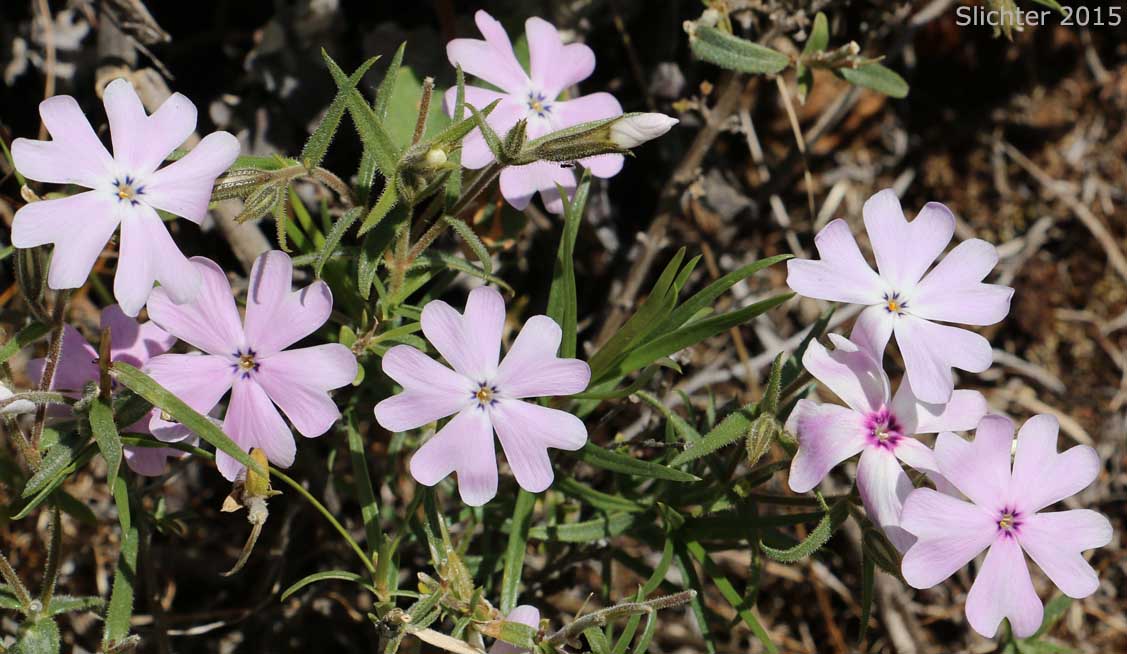
Showy phlox blooming in the northwest corner of the Columbia Hills State Park...........April 16, 2015.
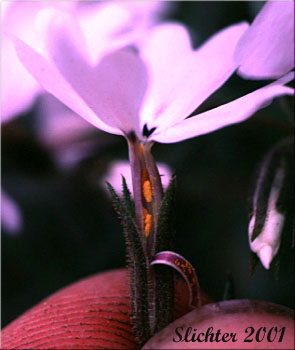 The photo at right shows the corolla tube opened to show
the stamens arranged at widely divergent levels in the flower of this species.
The membrane between the calyx lobes of this species are typically non-keeled
or only slightly keeled, while the similar long-leaf phlox
has membranes between the calyx lobes that are strongly keeled and bulged outwards
from the calyx.
The photo at right shows the corolla tube opened to show
the stamens arranged at widely divergent levels in the flower of this species.
The membrane between the calyx lobes of this species are typically non-keeled
or only slightly keeled, while the similar long-leaf phlox
has membranes between the calyx lobes that are strongly keeled and bulged outwards
from the calyx.
Characteristics:
Showy phlox is pretty perennial phlox with a shrubby base, with
multiple stems which may rise from 15 to 40 cm high. Plants may be found winding
up through the foliage of other medium height plants such as sagebrush) or found
growing in the open by themselves. The herbage is glandular to glandular-hairy
above and often glabrous below. The leaves are linear to broadly lanceolate,
measuring up to 7 cm long and 1 cm wide. The leaves are opposite on the stems,
and are widely spaced.
The inflorescence is a loose cyme. Individual corollas are pink
to white, typically with notched lobes. The tube is 10 to 15 mm long, with the
lobes an equal length. The calyx is about equal in length to the tube. The membranes
between the calyx ribs are flat to slightly keeled. The style is very short
(0.5-2 mm long) and is divided near the base into 3 linear stigmas which are
longer than the style.
To my knowledge, no one is offering this plant for sale from
nurseries, but it would be very attractive in the rockery or low shrubland garden
to the east of the Cascades. Generally, this species and its cousin, the long-leaf
phlox (See below.) do not do well west of the Cascades, even in good drainage
because of the excessive moisture there.
Similar Species:
Long-leaf Phlox: Phlox longifolia
- Corolla lobes not notched at their tips. A long style is present, measuring
from 6-15 mm long. Membranes between the calyx lobes strongly keeled and bulged
outwards from the calyx.
Habitat:
Showy phlox is a wildflower of sagebrush, low, arid shrubland
and open ponderosa pine forest habitats.
Range:
Showy phlox is found from the Okanogan valley of southern British
Columbia, south to the Oregon side of the Columbia River. It is also found in
southwestern Oregon and southward through the Sierra Nevada Mts into California.
Eastward, its distribution extends to northern Idaho and western Montana.
In the Columbia River Gorge, it may be found between the elevations
of 600'-3000' from Viento State Park in the west to the eastern end of the gorge.
 --
-- 
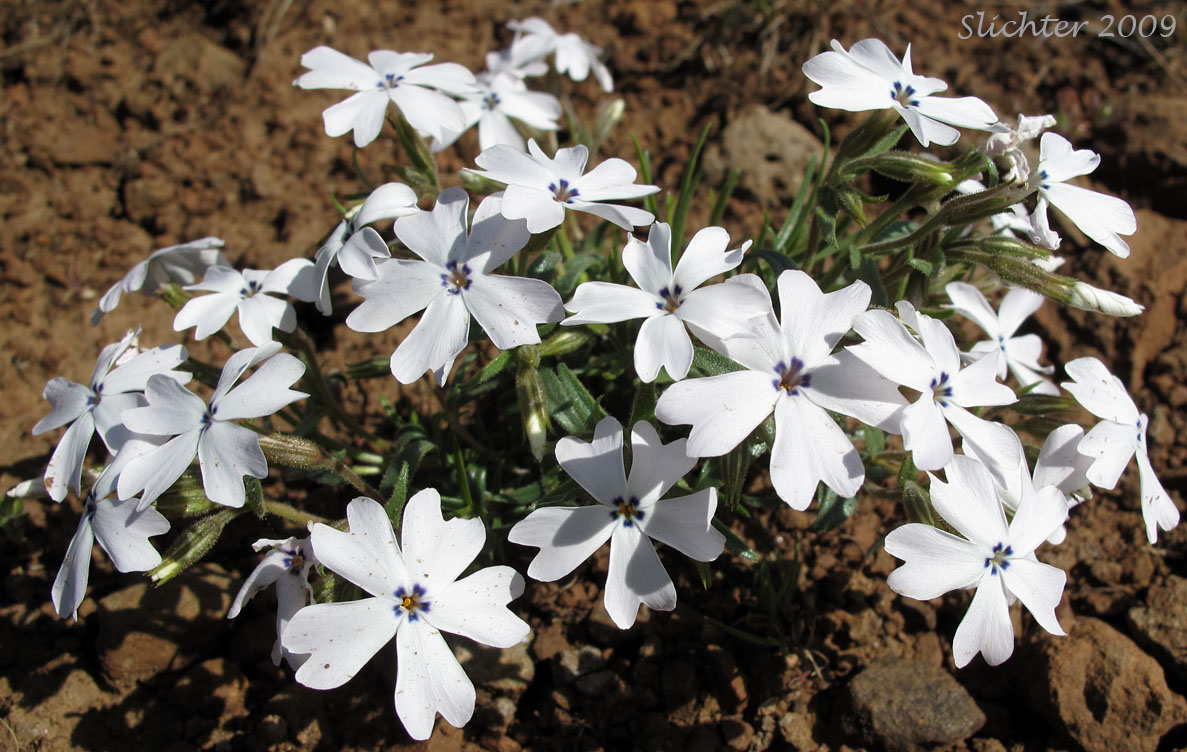
Showy phlox as seen in the Columbia Hills Natural Area Preserve, Columbia River Gorge...........May 10, 2009. Note that there is no papery membrane that bulges outwards between the calyx lobes. Presence of such a membrane (plus non-notched petal tips) indicates the similar long-leaf phlox (Phlox longifolia).
 -
- 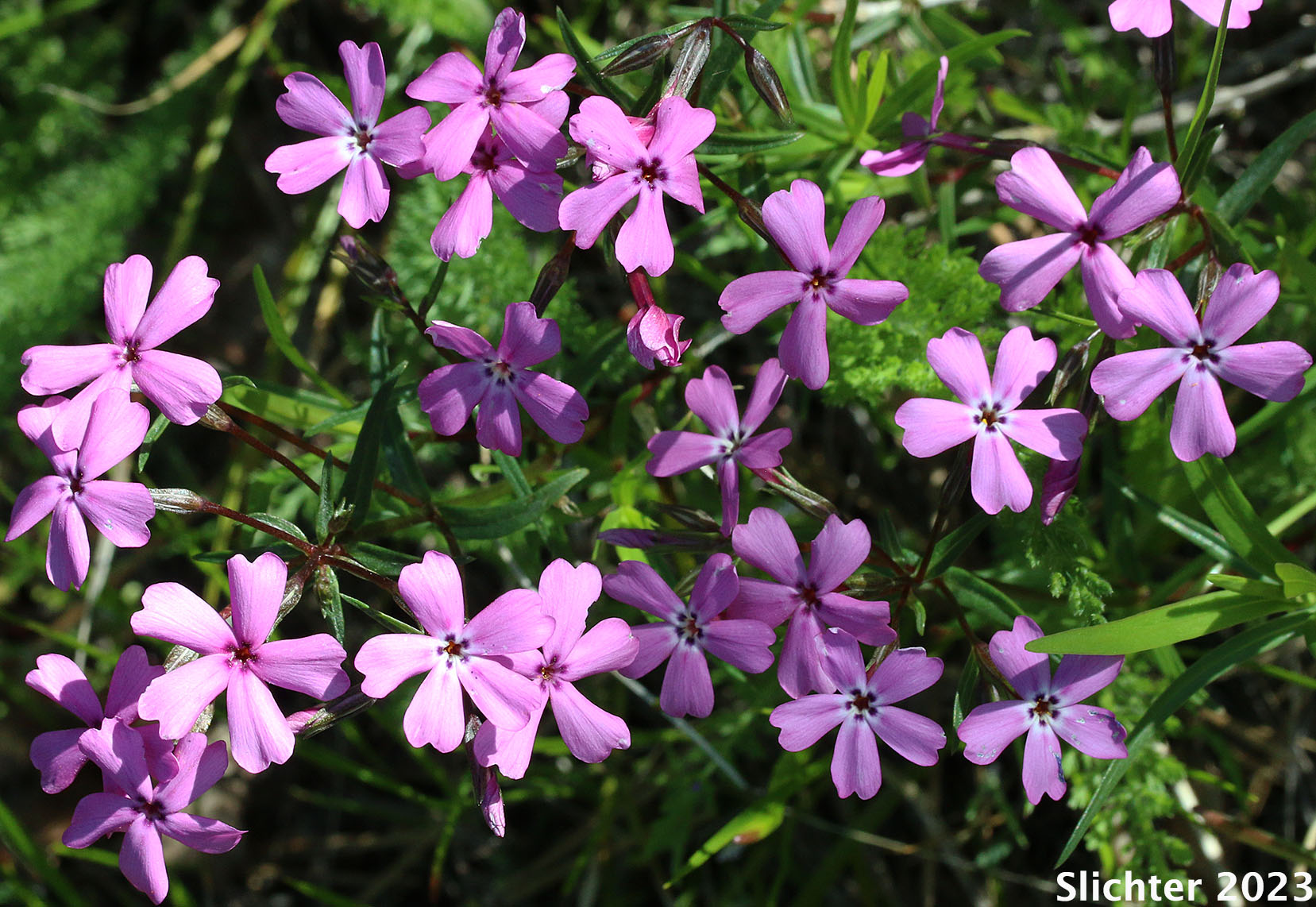
Masses of showy phlox blooming at left in grasslands along US Highway 97 on the Maryhill Grade, Klickitat County, WA.......May 13, 2019. The photo at right shows a nice pink form of showy phlox as observed on dry, open slopes above Winegartner Valley, several miles north of BZ Corner, WA......May 12, 2023.
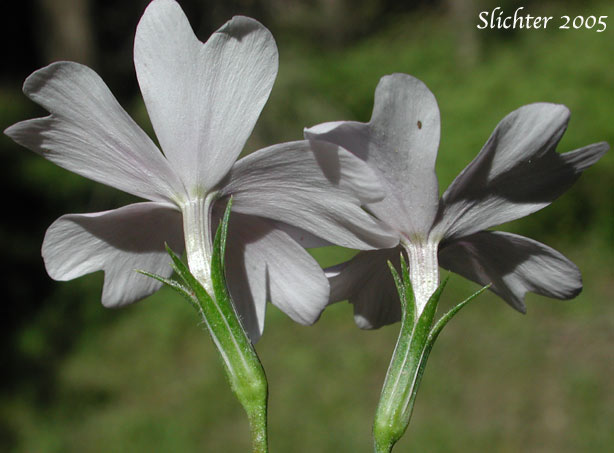
The photo above shows the calyx and corolla
tube of showy phlox as seen along forest road #82 just below spur road #190
on the southeastern side of Mt. Adams........July 1, 2005. The intercostal
membrane between the calyx lobes of this species are typically flat or sometimes
slightly ridged (as seen above). The similar
long-leaf phlox (
Phlox longifolia)
has strongly ridged or folded intercostal membranes between the calyx lobes.
 -
- 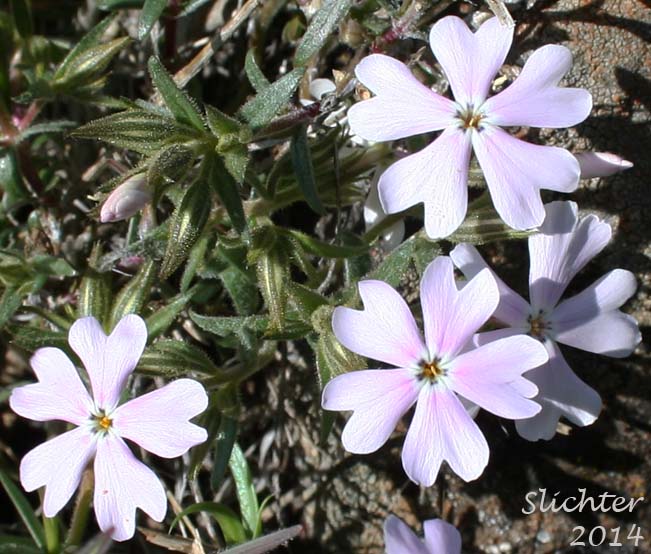
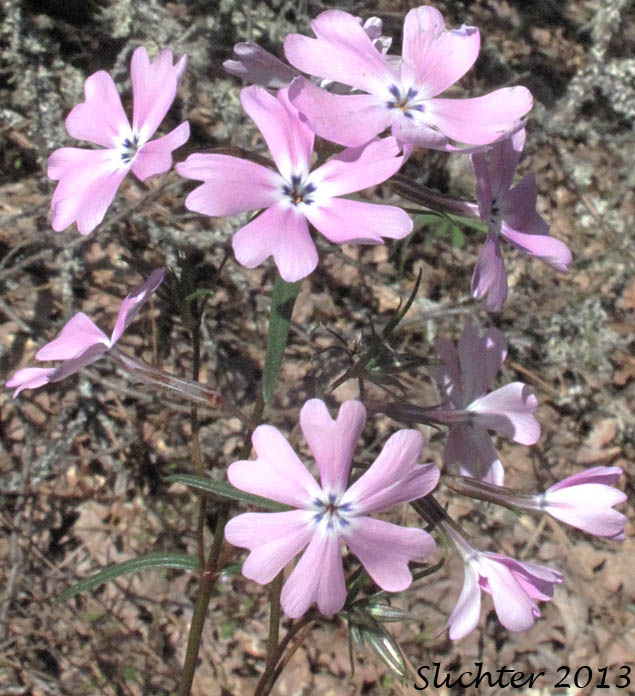
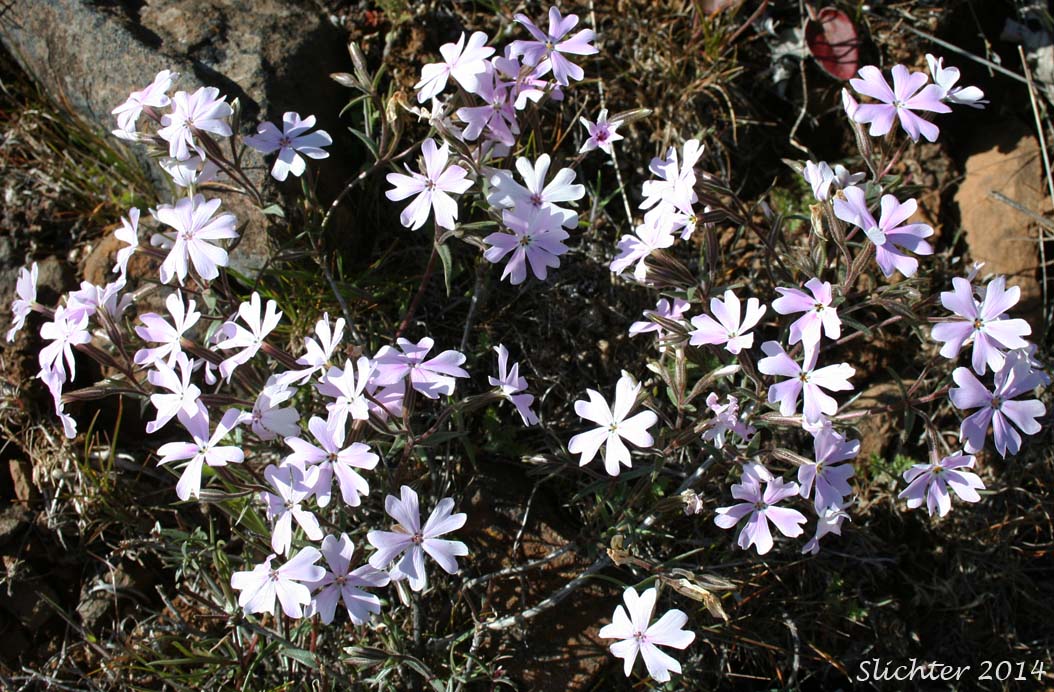
Showy phlox blooming at left in oak forest along the west side of the Klickitat River about one mile south of Beeks Canyon, Klickitat Wildlife Area...........April 18, 2013. The photo at right shows some of the first showy phlox to bloom high in the Columbia Hills State Park...........April 12, 2014.
 -
- 
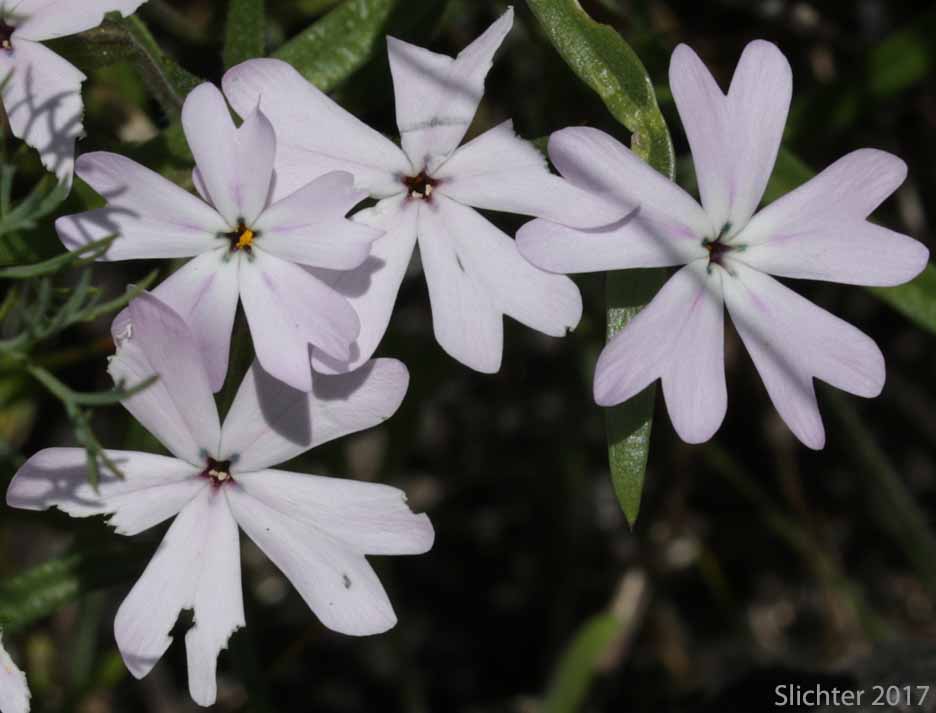
Showy phlox as seen at left on slopes above a stream in Brooks Memorial State Park, Klickitat County, WA..........April 28, 2014. The photo at right shows showy phlox begining to bloom in the Columbia Hills Natural Area Preserve......April 5, 2023.
 -
- 
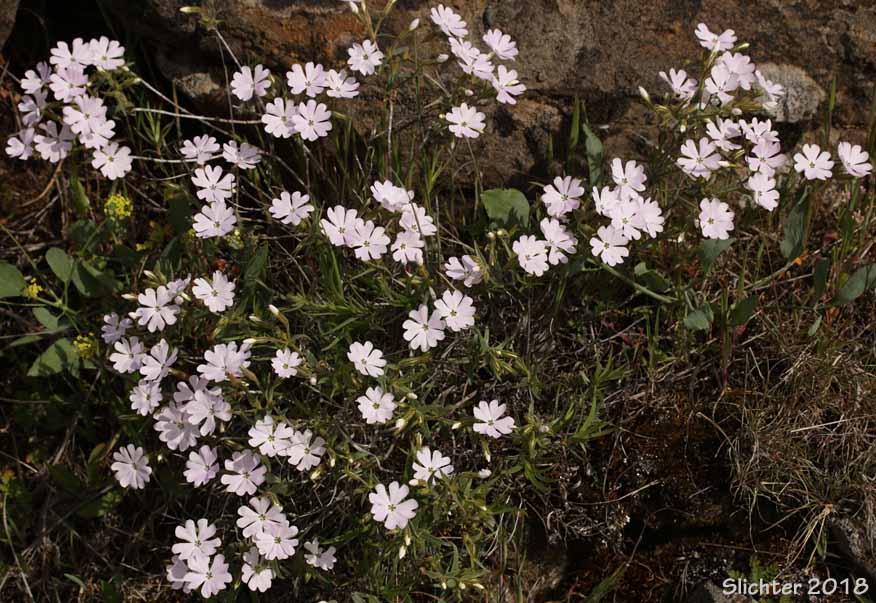
Showy phlox blooming at left on slopes above Canyon Creek, Klickitat Wildlife Area..........May 17, 2017. The photo at right shows a mass of showy phlox in bloom along paths between the Dalles Mountain Ranch and Crawford Oaks trailheads at Columbia Hills State Park......May 2, 2018.
 -
- 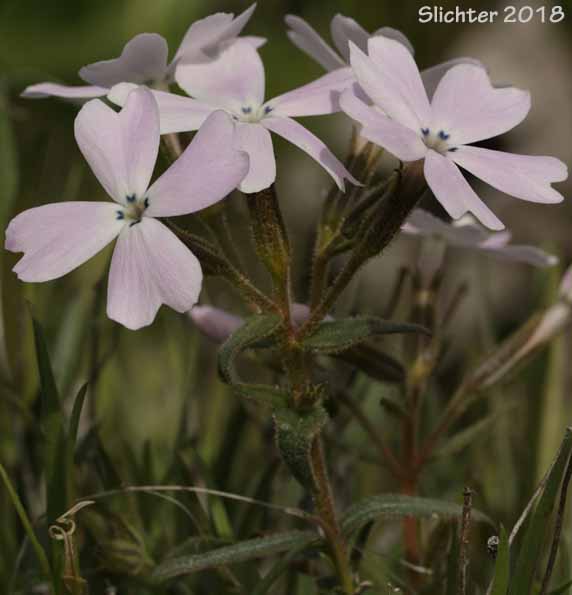
Showy phlox blooming on slopes above the Crawford Oaks trailhead at Columbia Hills Historical State Park.......May 5, 2018.
 -
- 
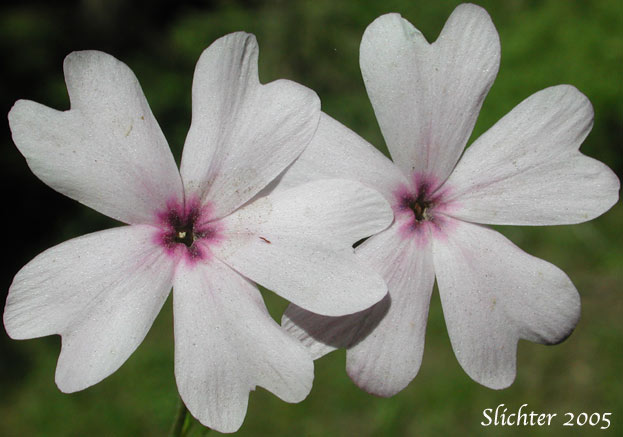
Showy phlox blooming on open slopes near the Dalles Mountain Ranch, Columbia Hills Historical State Park.....April 22, 2022.
 -
- 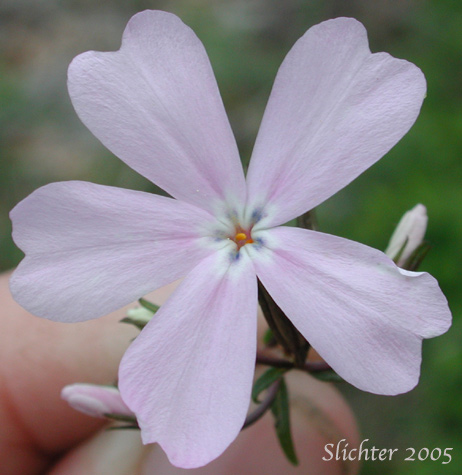
These photos show the widely spreading corolla lobes of the flowers of showy phlox
as seen along forest road #82 just below spur road #190 on the southeastern
side of Mt. Adams..........July 1, 2005. Note that the tips of the corolla
lobes are notched which can help distinguish this species from long-leaf phlox (Phlox longifolia).
Paul Slichter