[Buttercups: The Genus Ranunculus in the Columbia River
Gorge of Oregon and Washington]
Water Buttercup, White Water Buttercup
Ranunculus aquatilis var. diffusus
Synonyms: Batrachium circinatum, Batrachium circinatum ssp. subrigidum, Batrachium longirostre, Ranunculus amphibius, Ranunculus aquatilis var. caespitosus, Ranunculus aquatilis var. capillaceus, Ranunculus aquatilis var. longirostris, Ranunculus aquatilis var. subrigidus, Ranunculus aquatilis var. trichophyllus, Ranunculus circinatus, Ranunculus circinatus var. subrigidus, Ranunculus longirostris, Ranunculus subrigidus, Ranunclus trichophyllus, Ranunculus trichophyllus var. trichophyllus, Ranunculus usneoides
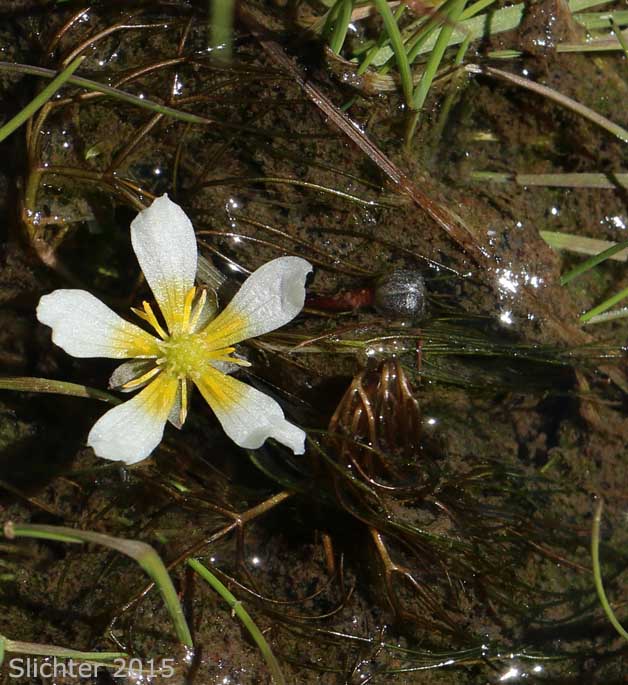
A flower and highly branched aquatic leaves of white water buttercup as seen in a small stock pond at the northwest corner of Columbia Hills State Park, Klickitat County.........April 16, 2015.
Characteristics:
White water buttercup is an aquatic, perennial wildflower with
lax, submerged stems measuring from 10-100 cm long. The herbage is somewhat
glabrous to pubescent and the lower nodes of the stem are known to root upon
touching bottom. The leaves alternate along the stems, the submerge leaves dissected
into many needle-like segments. The lower leaves are typically sessile while
the upper leaves may have petioles measuring up to 2 cm long. The floating leaves
are similar to the lower leaves but are 5-15 mm long and nearly twice as wide,
the blades blades shallowly to deeply 3-lobed and with toothed or lobed segments.
The 5 greenish sepals measure from 2-5 mm long and are soon
deciduous. The 5 white petals (sometimes yellowish toward their bases) measure
from 5-10 mm long. The stamens number from 10-15.
Habitat:
White water buttercup is found in slow moving streams, ditches,
or ponds and occasionally on mud.
Range:
White water buttercup may be found in moist habitats throughout
much of North America and Europe.
In the Columbia River Gorge it may be found between the elevations
of 100'-3600' between the Wind River and Horsethief Lake State Park.
 -
- 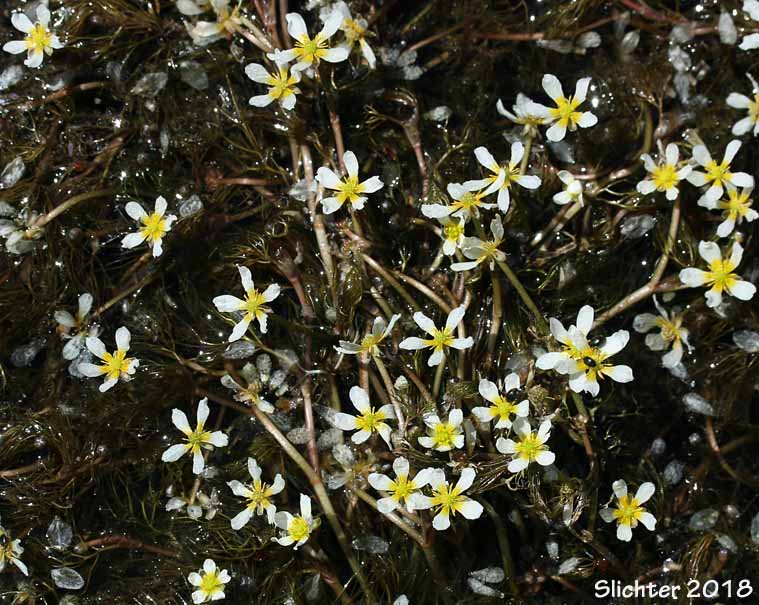
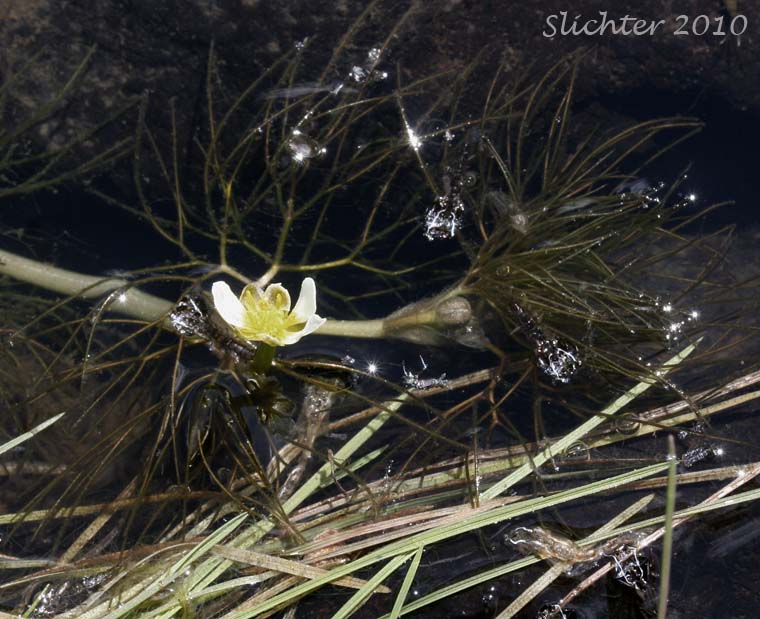
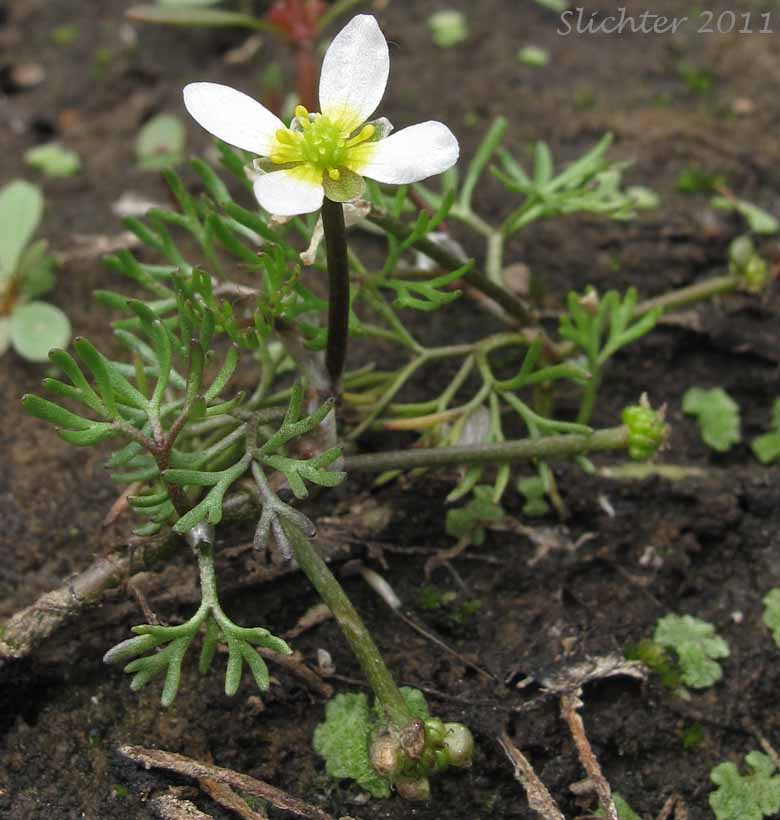
A flower and highly branched aquatic leaves of white water buttercup as seen at left in upper Swale Creek, Klickitat County........May 8, 2010. These leaves are used primarily for support, helping keep the plant oriented just below the surface of the water. The photo at right shows white water buttercup as seen in a vernally moist stream at Columbia Hills State Park......May 2, 2018.
 -
-  -
- 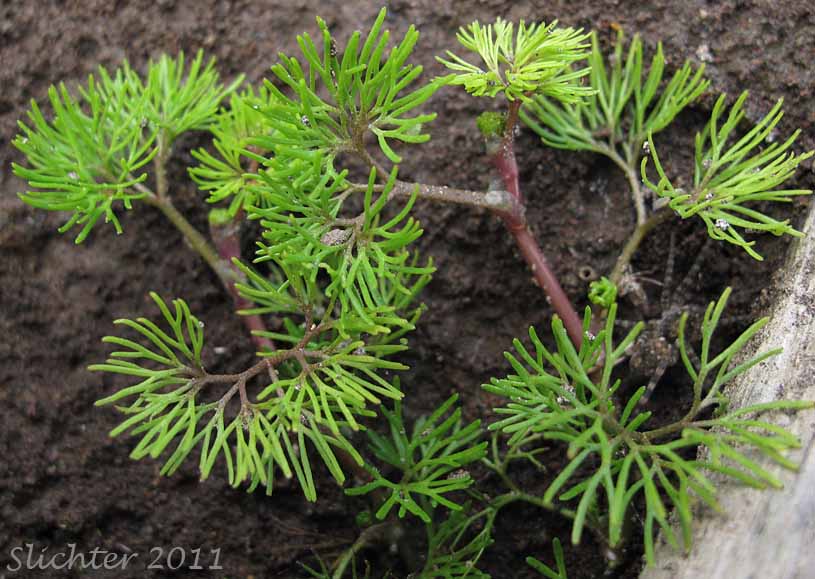
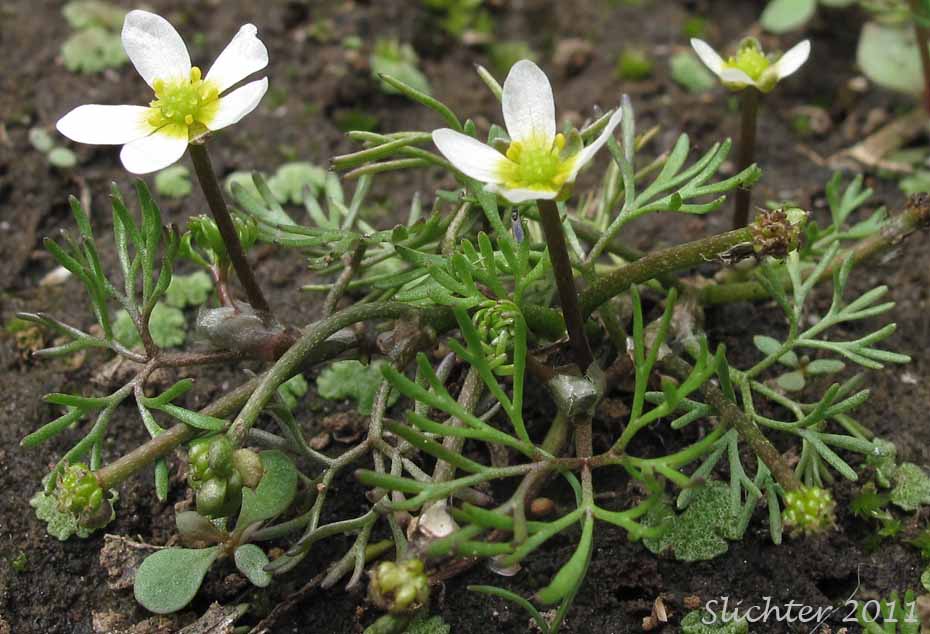
Examples of white water buttercup (var. aquatilis?) as seen on a moist sandbar along the Klickitat River at Beeks Canyon, Klickitat County, Washington.........July 21, 2011.
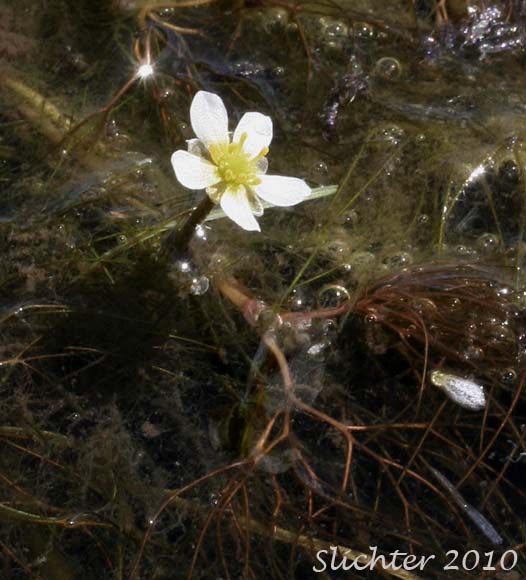
A flower and highly branched aquatic leaves of white water buttercup as seen in upper Swale Creek, Klickitat County.........May 8, 2010.
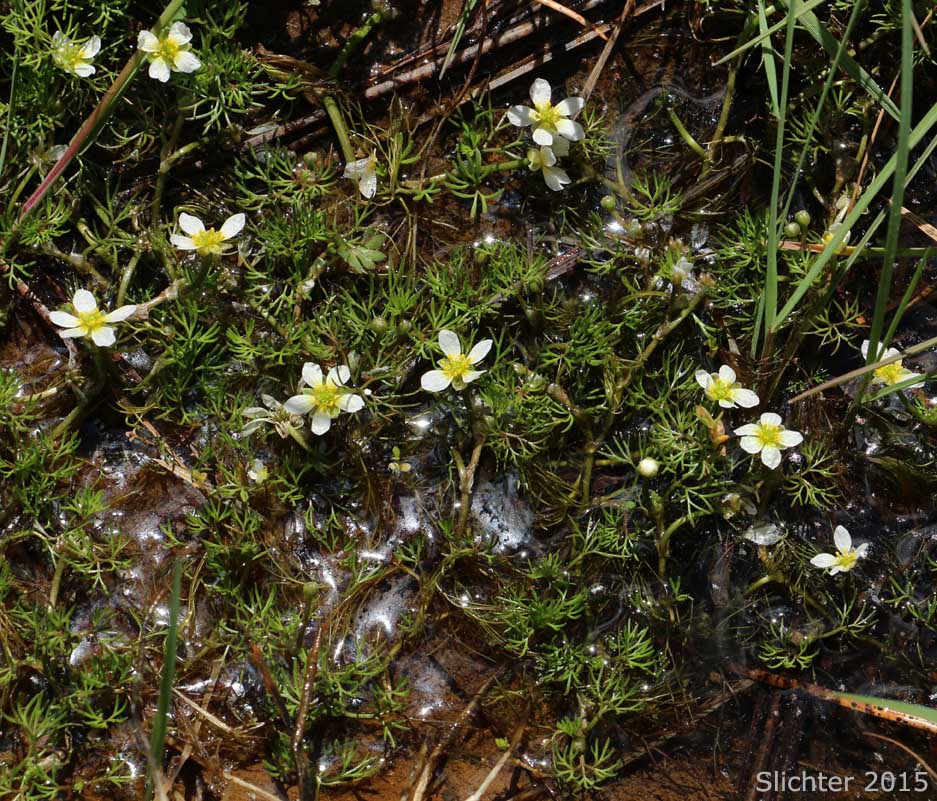
A flower and highly branched aquatic leaves of white water buttercup as seen in upper Swale Creek, Klickitat County.........May 8, 2010.
Paul Slichter