[The Mustard Family in
the Columbia River Gorge of Oregon and Washington]
Fringepod, Sand Fringepod, Hairy Fringepod, Lacepod
Thysanocarpus curvipes
Synonyms: Thysanocarpus curvipes ssp. curvipes, Thysanocarpus curvipes var. curvipes, Thysanocarpus curvipes var. elegans, Thysanocarpus curvipes var. longistylus
 -
- 
The photo at left shows the interesting seed pods of
fringepod as seen along the Horsethief Butte Trail several miles northeast
of The Dalles, OR..............April 24, 2006. The photo at right shows the fruiting inflorescence of fringepod as seen around the Dalles Mountain Ranch at Columbia Hills Historical State Park......April 22, 2022.
Characteristics:
Fringe pod is a interesting annual with distinctive
seed capsules as seen above. Its stems are simple to branched, with the stems
arising from 15-80 cm high. It is somewhat stiffly haired below, and smooth
above. The basal leaves are usually deciduous by bloom time. They are oblanceolate
in shape, from 1.5-5 cm in length. The stem leaves are smaller, becoming oblong
or narrowly lanceolate.
The 4 sepals are about 1 mm long, with purple coloration
and white margins. The 4 narrow petals are white or purplish, and are about
as long as the sepals. The unique silicles are orbicular, oval, elliptic, or
obovate, bordered with a wide, radiately nerved wing.
Habitat:
Fringe pod is found on open slopes and at the
edge of woodlands.
Range:
Fringe pod is found east of the Cascade Mts from
British Columbia south to California, and east to Idaho.
In the Columbia River Gorge it may be found between
the elevations of 100'-3000' from near the mouth of the Wind River and eastward
past Biggs, OR.
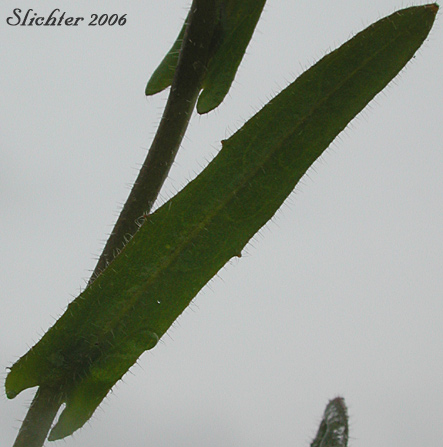
The photo above shows the outline of a mid-stem
leaf of fringe pod. Note the spreading hairs along the margin and "auriculate" base to the leaf. Note also the presence of several minute, triangular teeth
along the margin of the blade.
 -
- 
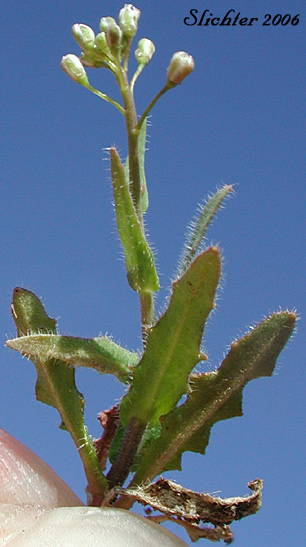
The photo above shows the basal leaves and
lower stem leaves of a very young fringe pod that has just begun to bloom. Note
the broad, triangular teeth along the margins of the lower blades and the numerous
spreading hairs of the lower stem. Photographed along the Dalles Mt.
Road near 1550'...........March 6, 2006.
 -
-  -
- 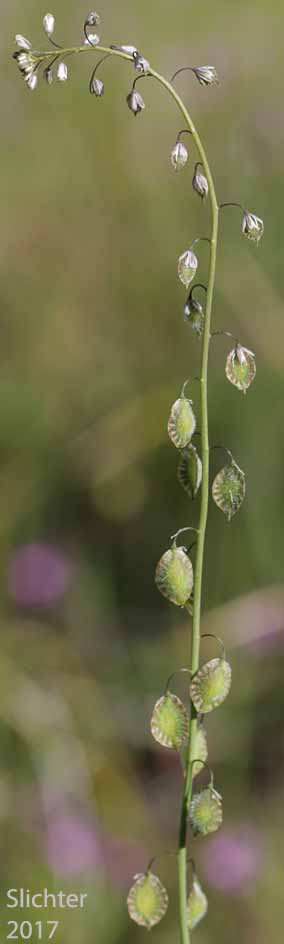
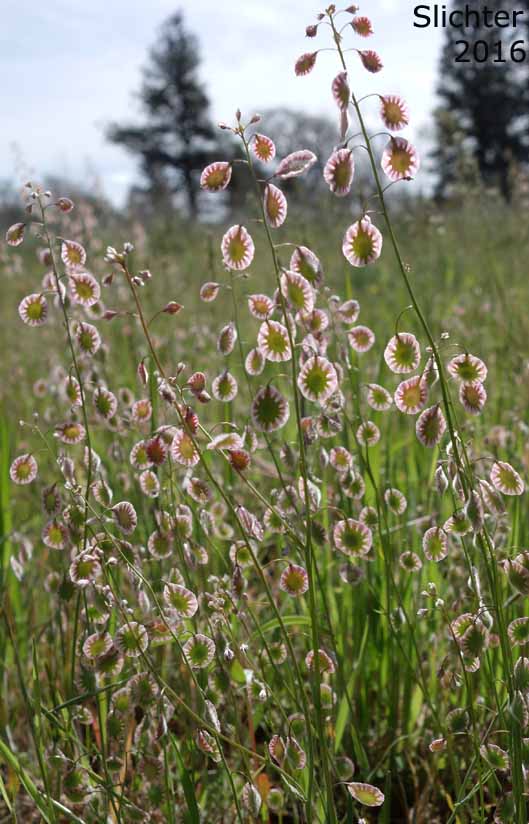
The photo at left shows fringepod fruits along trails at the Deschutes River State Recreation Area......April 6, 2024. Lacepods with their attractive fruits as seen at center on the grounds of The Dalles Discovery Center........April 5, 2016. The photo at right shows the fruits of lacepod forming on a plant seen along the east bank of the Deschutes River, Deschutes River State Recreation Area.........March 31, 2017.
 -
-  -
- 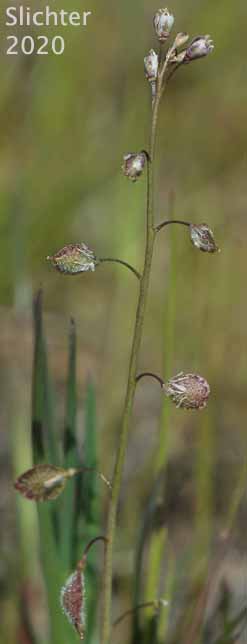
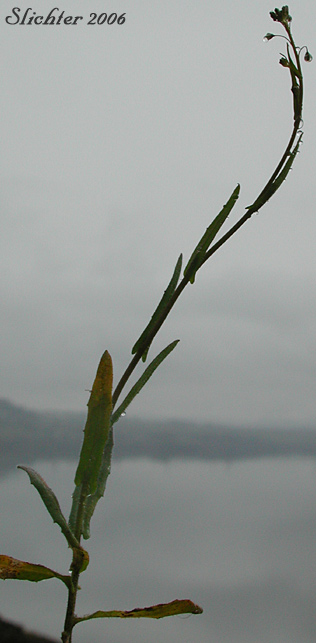
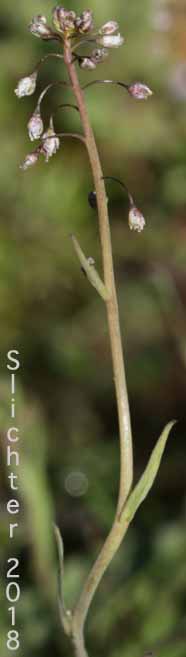
The photo at left shows the lower to upper stem and inflorescence
of fringe pod as seen on basalt cliffs above Doug's Beach, WA State Road #14,
MP 79...........March 11, 2006. Note that the lower leaves begin to whither
and dry up as the plant begins to flower. The photo at center shows fringe pods in bloom as seen along the Memaloose Trail east of Mosier, OR.......March 20, 2018. The photo at rights shows fringepod atop Millc Creek Ridge, Wasco County, OR......March 17, 2020.
Paul Slichter