[Drabas and Whitlow-grasses: The Genus Draba in the Columbia River Gorge of Oregon and Washington]
Spring Draba, Spring Whitlow-grass
Draba verna
Synonyms: Draba verna var. aestivalis, Draba verna var. boerhaavii, Draba verna var. major, Draba verna var. verna, Erophila verna ssp. spathulata, Erophila verna var. praecox, Erophila verna var. verna
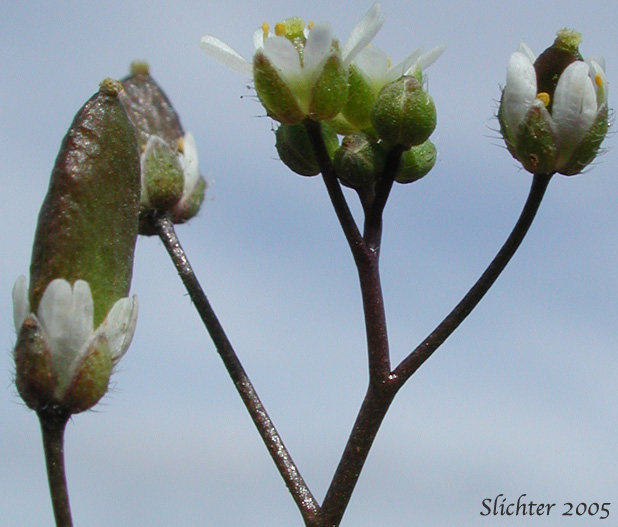
Spring whitlow-grass as seen near the crest of the Columbia Hills
in the Columbia River Gorge.......late April, 2005. Note the broad silicle
emerging from the flower at right. Note also the deeply bi-lobed petals, a characteristic
of this species.
Characteristics:
Spring whitlow-grass is a small annual that is easy to overlook
because of its diminutive size, yet it is often one of the most abundant flowering
plants underfoot in the west. The leaves are basal, in a rosette, and are often
covered with stiff, branched hairs. The leaf shape ranges from spatulate to
oblanceolate, with entire to toothed leaf margins. The leaves range from 10-25
mm long. The one to several stems range from 5-20 cm tall, and are leafless.
The lower stem, basal leaves and sepals are covered with simple to three-forked
hairs (See photos.).
The inflorescence is a loose raceme with 3-20 flowers. The 4
white petals are cleft or split so the flowers look like they have 8 petals.
The petals are about 2.5 mm long. The flowers and later the seed capsules alternate
along the stem. The seed capsules of variety boerhaavii are elliptic-obovate
to obovate silicles, which average 4-5 mm long and 3.5 mm wide.
Habitat:
Spring whitlow-grass grows on dry open ground, often in grassy
plains.
Range:
Spring whitlow-grass is found throughout much of North America.
In the Columbia River Gorge, spring whitlow-grass may be found
from 100'-3000' from the western mouth of the gorge and hence east past Biggs,
OR.
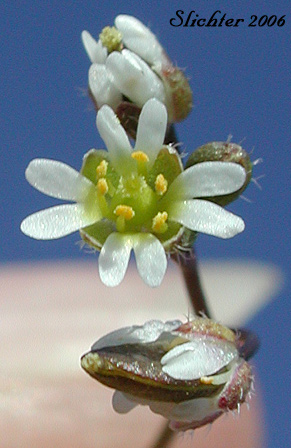
The photo above shows a close-up of the flower
of spring whitlow grass as seen at about 1600' along the Dalles Mt. Rd in the
Columbia River Gorge.........March 6, 2006. Note the deeply cleft petals
and long hairs on the outer surface of the sepals.
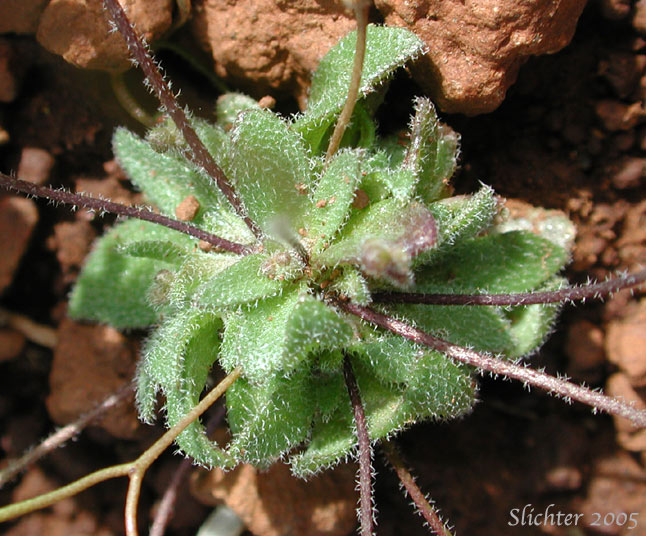
The photo above shows the basal cluster of leaves. Note the numerous
branched hairs on the stems and both leaf surfaces. Photographed near the crest
of the Columbia Hills in the Columbia River Gorge......late April, 2005.
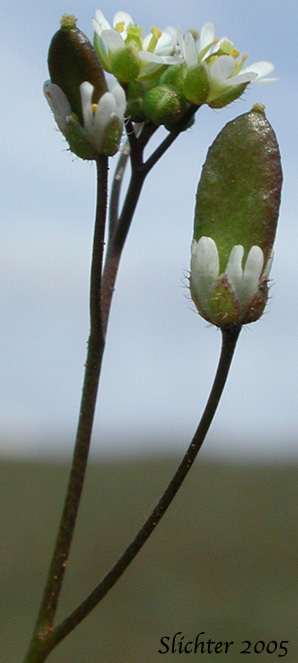
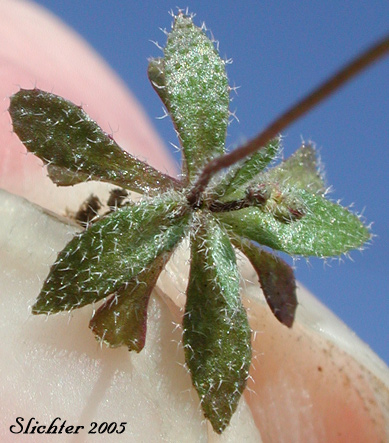
The photo above shows another close-up of the
basal leaves of spring whitlow grass as seen at about 1600' along the Dalles
Mt. Rd in the Columbia River Gorge.........March 6, 2006. Note the forked
hairs on the upper leaf surface.
 -
- 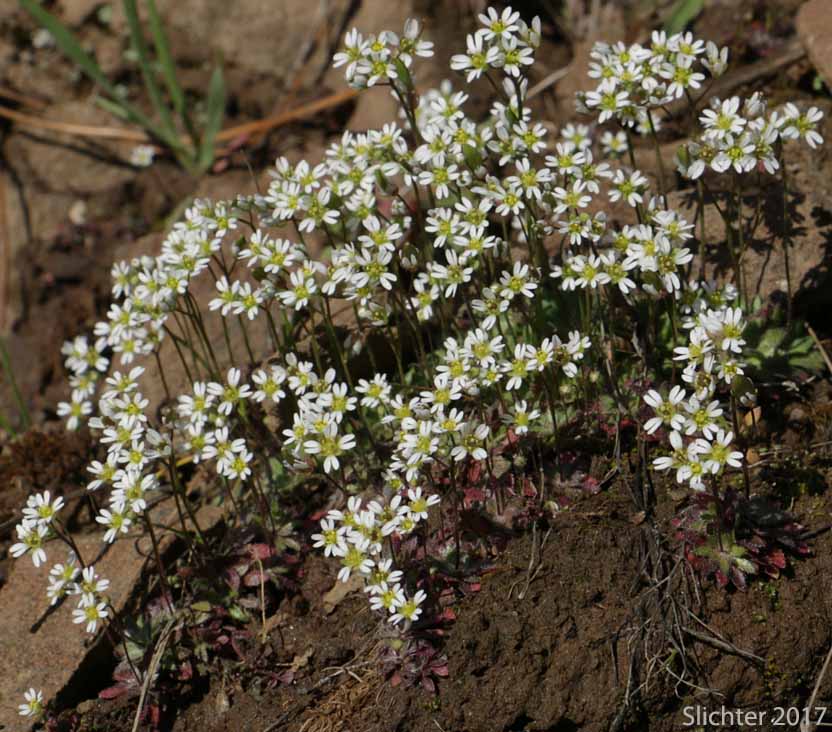
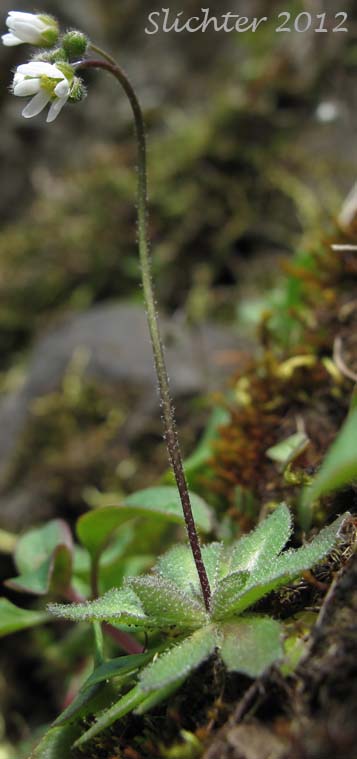
Spring whitlow grass as seen at left on steep slopes along the Eagle Creek Trail, Columbia River Gorge..........March 26, 2012. The photo at right shows a mass of spring whitlow grass in bloom along the Lyle Cherry Orchard Trail.......March 16, 2017.
 -
- 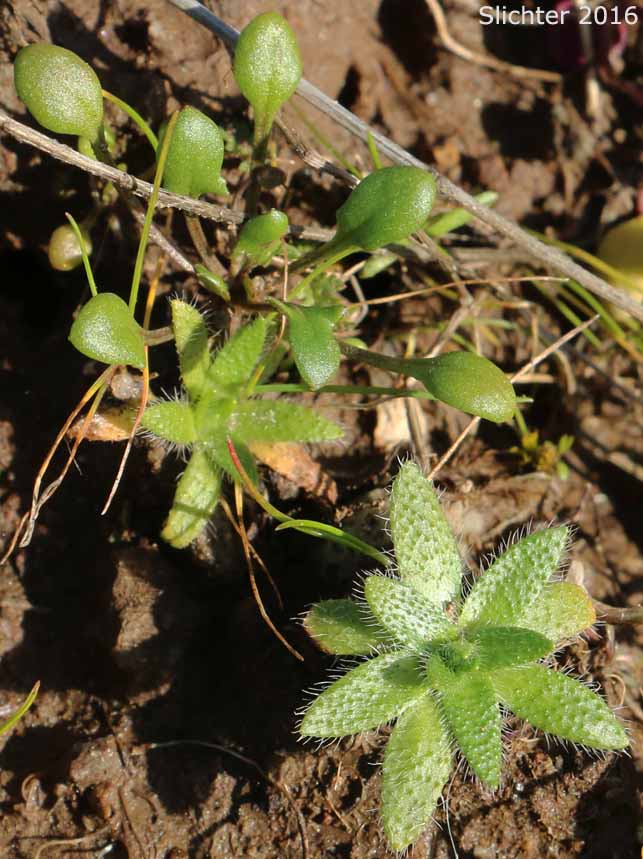
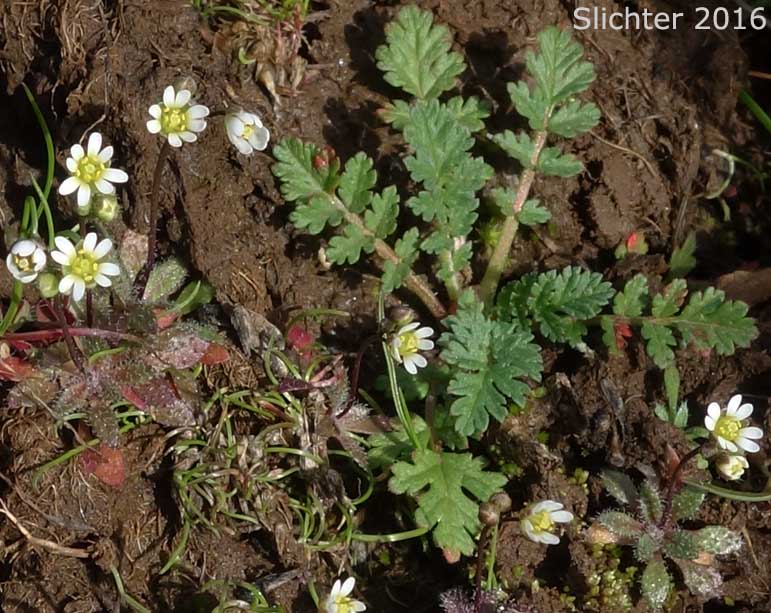
Spring whitlow-grass blooming (left) alongside the basal leaves of filaree (Erodium cicutarium) in an area burned by wildfire during the summer of 2014 on Sevenmile Hill outside The Dalles, Oregon..........February 15, 2016. The photo at right shows the basal leaves of scale pod (Idahoa scapigera) and spring whitlow-grass as seen south of Old Highway 30 about one-half mile west of Marsh Cutoff Road, Columbia River Gorge............. February 7, 2016 .
 -
-  -
- 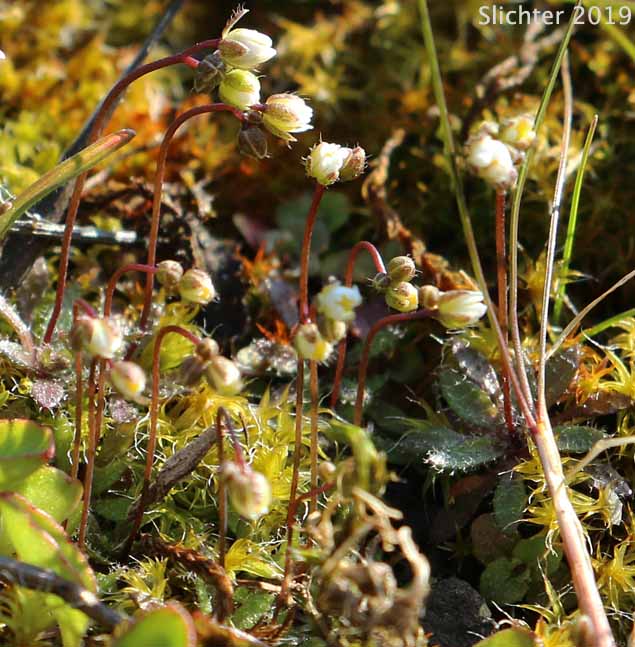
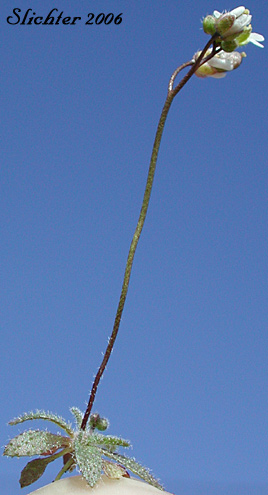
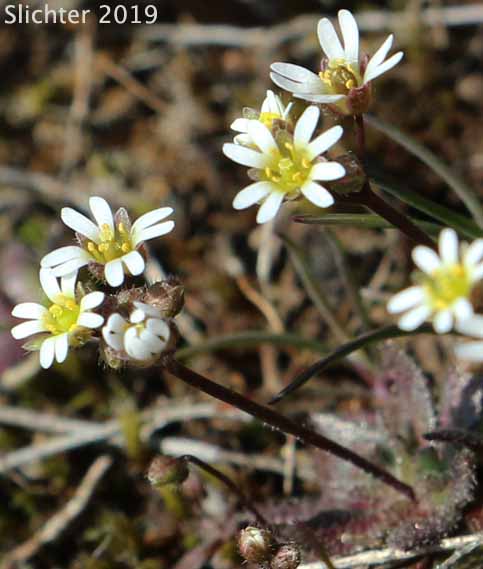
The photo at left shows the simple stem with
a few branches within the inflorescence as seen at Columbia Hills Historical State Park. Note the hairs on the lower stem........March
6, 2006. The photos at center and right show spring whitlow-grass beginning to bloom at Catherine Creek, Columbia River Gorge......March 17, 2019.
 -
- 
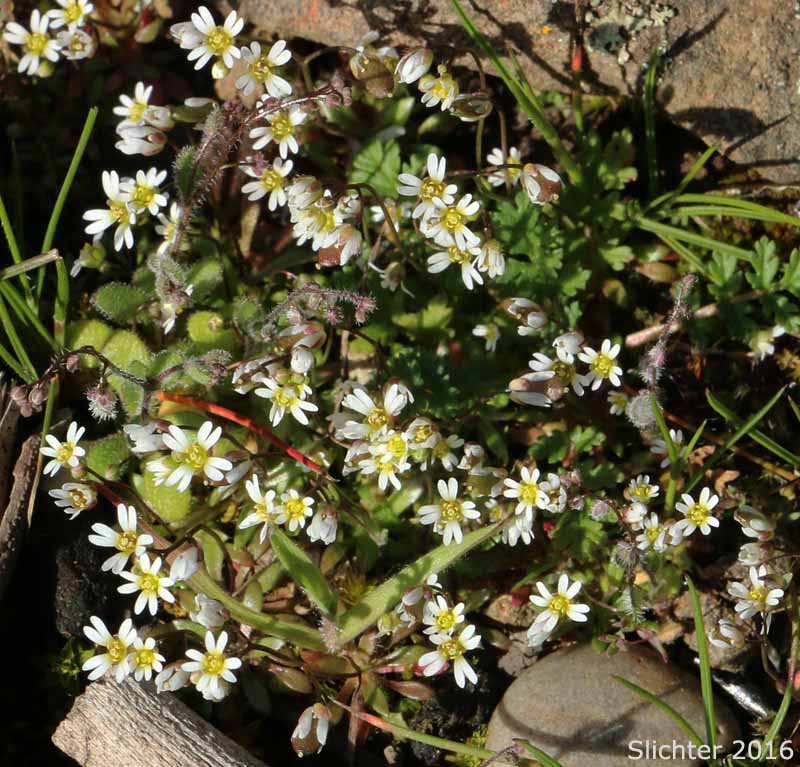
A mass of spring whitlow-grass in bloom along the old road adjacent to the vernal waterfall above the Crawford Oaks trailhead, Columbia Hills State Park.........February 23, 2016.
 -
- 
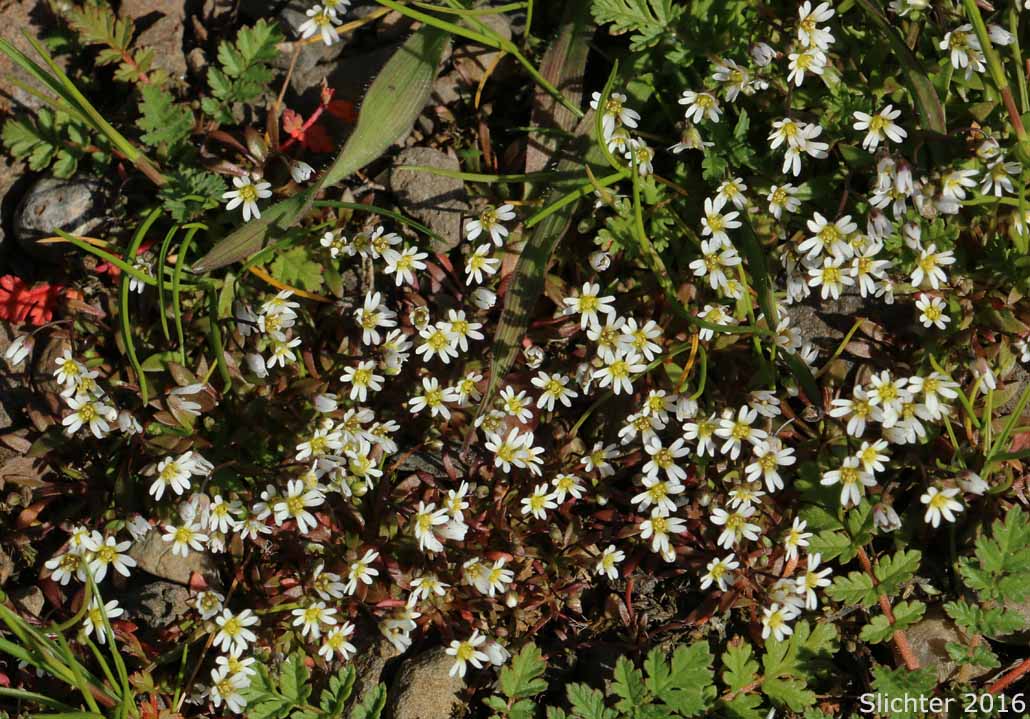
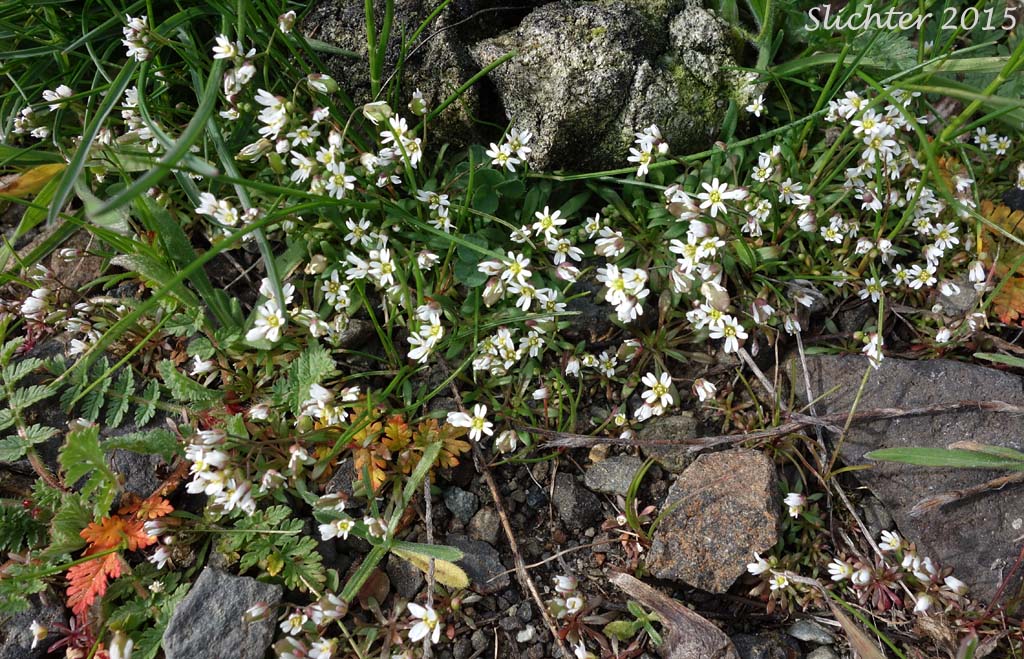
A mass of spring whitlow-grass in bloom at left along the old road adjacent to the vernal waterfall above the Crawford Oaks trailhead, Columbia Hills State Park.........February 18, 2015. The photo at right shows spring whitlow grass blooming along trails above the east bank of the Deschutes River several miles upstream of the Columbia River......February 6, 2022.
 -
- 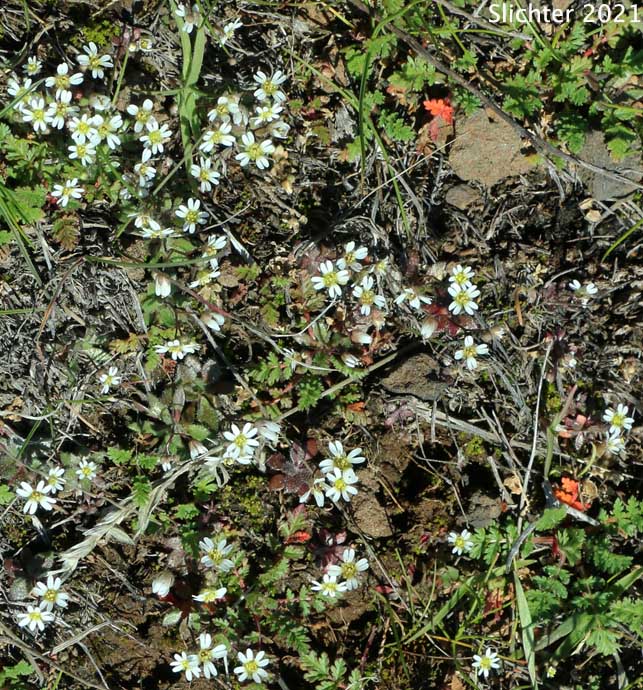
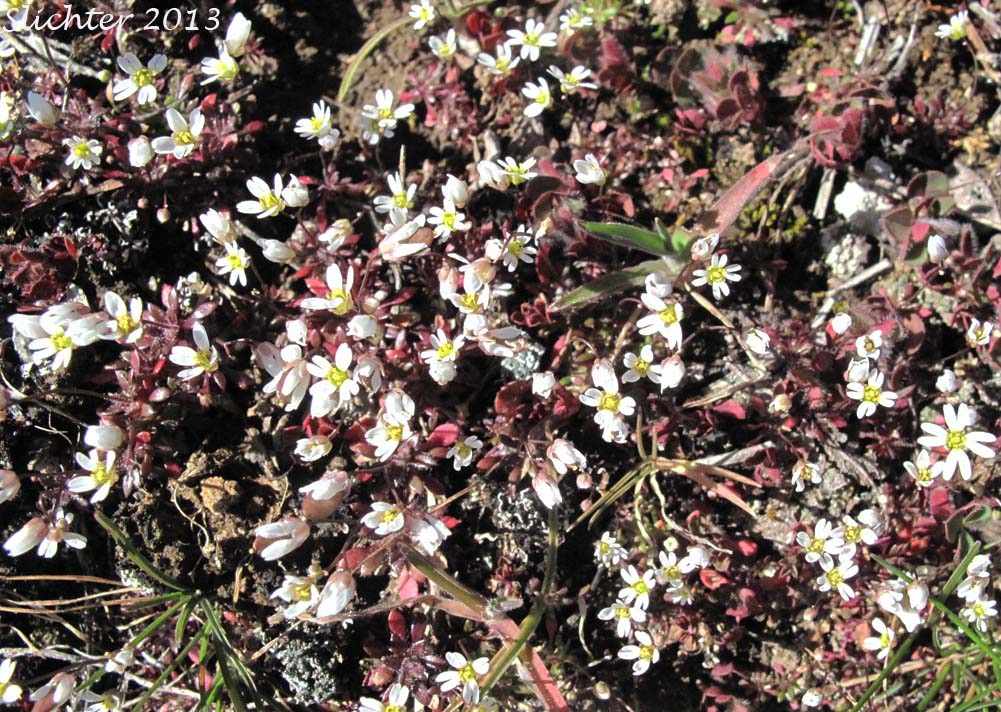
Massed bloom of spring whitlow-grass as seen at left on the western rim of Chenoweth Table at the western outskirts of The Dalles, Oregon.......March 9, 2013.
The photo at right shows spring whitlow-grass in bloom along the old road adjacent to the vernal waterfall above the Crawford Oaks trailhead, Columbia Hills State Park........November 24, 2021.
Paul Slichter