[Buckwheats: The Genus Eriogonum in the Columbia River
Gorge of Oregon and Washington]
Broom Buckwheat, Wickerstem Buckwheat, Wire-stem Buckwheat
Eriogonum vimineum
Synonyms: Eriogonum shoshonense, Eriogonum vimineum ssp. shoshonense, Eriogonum vimineum var. shoshonense, Eriogonum vimineum var. shoshonense, Eriogonum vimineum var. vimineum
 -
- 
The photo at left shows a close-up of several flowers within the inflorescence of broom buckwheat. Photographed along Washington Highway 14 above Wishram, WA........October 7, 2006. The photo at right shows the form of broom buckwheat as seen along the road above the Crawford Oaks Trailhead, Columbia Hills Historical State Park......October 31, 2020.

The photo at right shows a close-up of a basal leaf blade of broom buckwheat. Photographed along Washington Highway 14 above Wishram, WA.........October 7, 2006.
Characteristics:
Broom buckwheat is an upright, non-mat forming buckwheat which
is an annual. The erect stem arises from 5-40 cm high from a rosette of basal
leaves, ovate to broadly elliptical in shape, which are mostly gray-tomentose
below, less tomentose to green above. The leaf blades are from 5-30 cm long,
nearly as wide, and have slender petioles, from 1-3 times as long as the blades.
The flower stem is branched two to three times, forming a cymose
inflorescence with minute white, yellow, or pink clusters of flowers scattered
the length of the branched stems.
Habitat:
Sandy or rocky soil from desert to sagebrush or pine forests.
Range:
A widespread species, Broom Buckwheat is found from Central
Washington, southward along the east side of the Cascades into Mexico, eastwards
towards the western edge of the Rocky Mts from southern Idaho to Arizona and
New Mexico.
In the Columbia River Gorge, it may be found between the elevations
of 100'-600' from Mosier, OR in the west to about Haystack Butte in the east.
 -
- 
Close-ups of the flowers of broom buckwheat, as seen blooming on slopes above the Crawford Oaks Trailhead, Columbia Hills State Park............October 12, 2013.
 -
-  -
- 
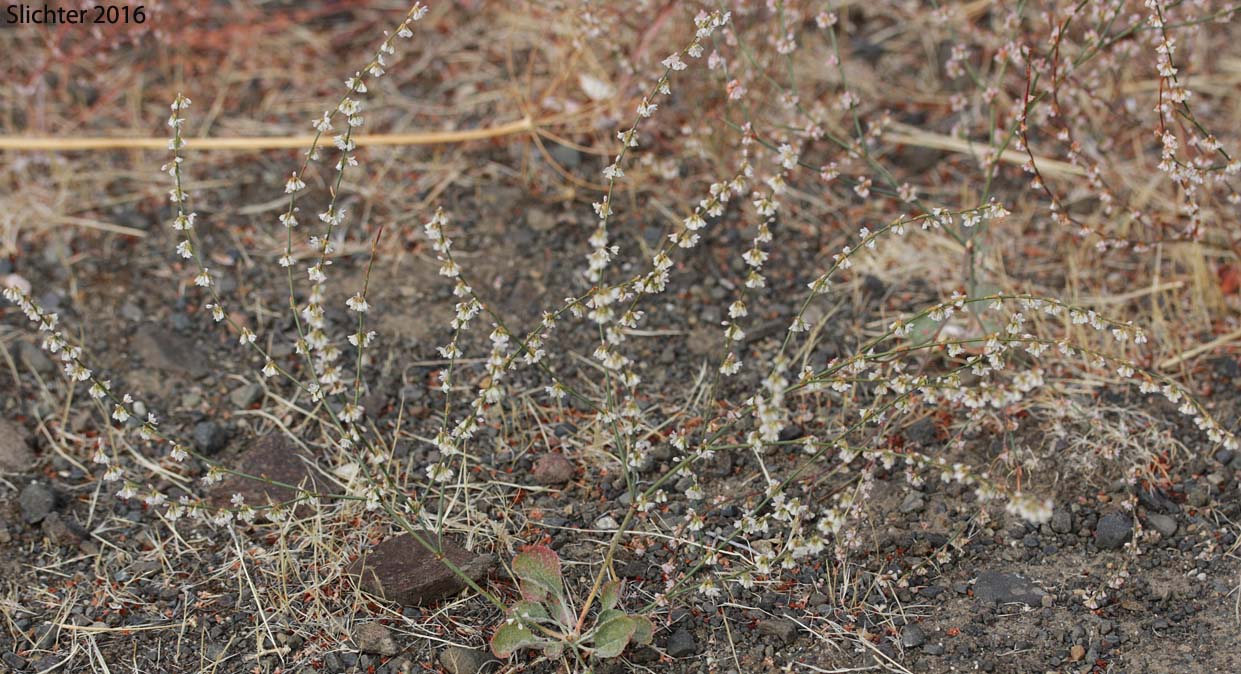
Broom buckwheat blooming along the road up to the top of the waterfall above the Crawford Oaks Trailhead, Columbia Hills State Park........October 6, 2016.
 -
- 
Broom buckwheat blooming
along the road up to the top of the waterfall above the Crawford Oaks Trailhead, Columbia Hills State Park........November 18, 2017.

Broom buckwheat blooming along the road up to the top of the waterfall above the Crawford Oaks Trailhead, Columbia Hills State Park........November 22, 2021.
 -
- 
The photo at left shows broom buckwheat in bloom along the service road up to the old Klickitat County Dump above the Crawford Oaks Trailhead at Columbia Hills Historical State Park......November 16, 2019. The photo at right shows Eriogonum baileyi from Fort Rock State Park, Fort Rock, OR....late July 15, 1994.
Paul Slichter