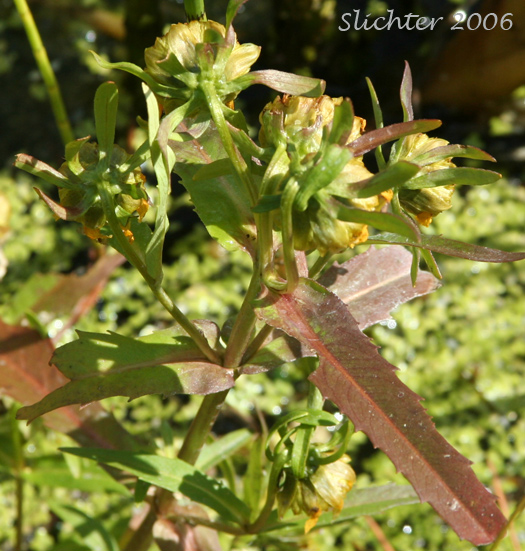
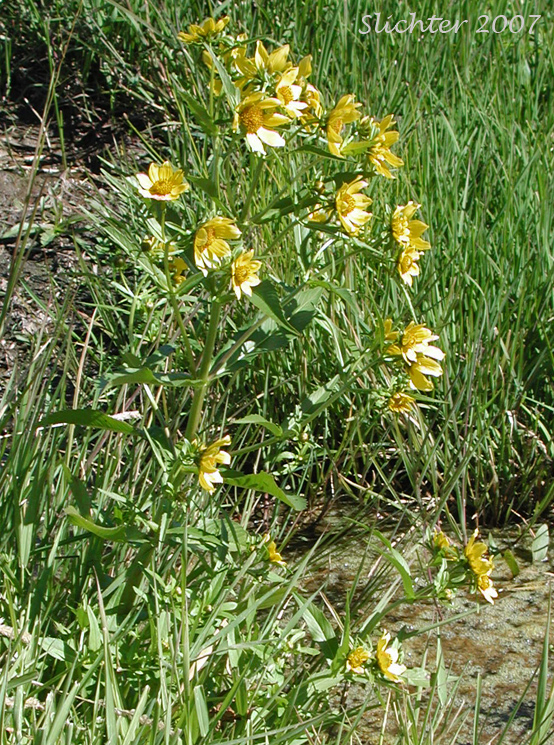
Nodding beggar ticks is a somewhat weedy annual with erect to ascending stems from 10-100 cm high. The stems are often branched with either a smooth or slightly rough herbage. The leaves are opposite and are slightly reduced in size upwards along the stem. Individual leaves are simple (as opposed to compound ternate in Bidens frondosa) with a lance-linear to lance-ovate shape (as seen at right) and subentire to coarsely serrate margin. The leaves range from 4-20 cm long and 5-45 mm wide.
The flower heads consist of both disk and ray flowers found at the ends of the main stems as well as on stems originating in the upper leaf axils. The yellowish rays typically number 6-8 although they may occasionally be missing. Individual rays measure to 1.5 cm long and from 1.2-2.5 cm wide. The numerous disk flowers are yellow to brownish in color with yellow stamens. The disk ranges from 12-25 mm wide. The flower heads commonly nod with age, hence the name "nodding" beggar ticks.
The involucre consist of 2 rows of dissimilar bracts. The outer row consists of 5-8 narrow, spreading or reflexed bracts while the inner row consists of wide, striped bracts. The fruits are wedge-shaped achenes with 4 long bristles covered with many tiny, reflexed barbs. The achenes range from 5-8 mm long.
Common beggar ticks Bidens frondosa: The leaves of common beggar ticks typically have petioles and are compound pinnate with 3-5 leaflets. The terminal leaflet is often slenderly petiolate. The flower heads lack ray flowers.
Nodding beggar ticks are found in low wet places such as found in ditches, vernal ponds, and the margins of rivers and streams.
Nodding beggar ticks is a widespread species of the northern hemisphere which was evidently introduced to the west coast from the east coast of the United States.