[Phlox: The Genus Phlox Found East of the Cascade
Mts. of Oregon and Washington]
Spreading Phlox
Phlox diffusa
Synonyms: Phlox diffusa ssp. diffusa, Phlox diffusa var. longistylis, Phlox diffusa ssp. longistylis
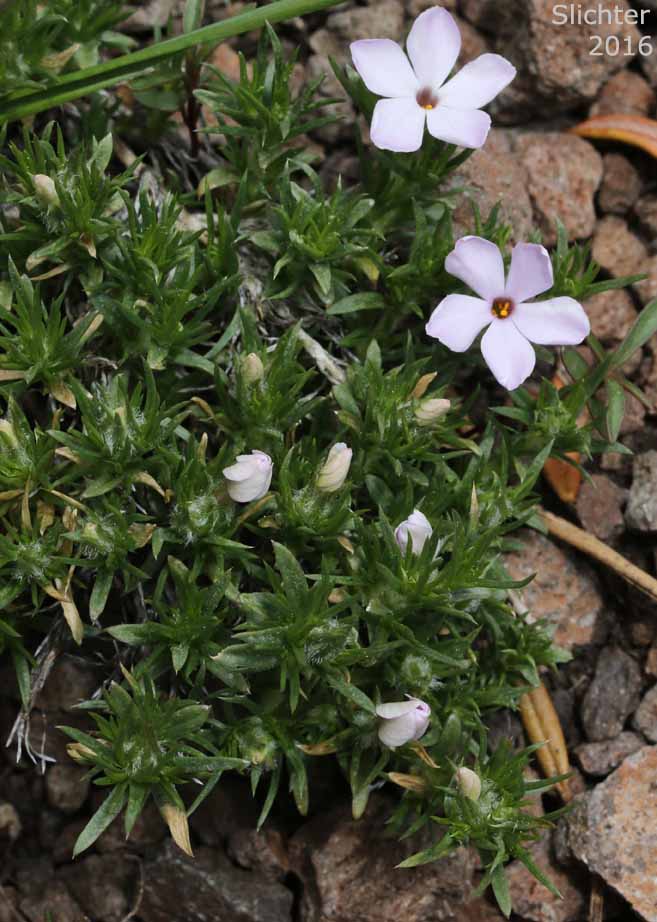
Spreading phlox blooming atop Hager Mountain, Fremont National Forest..........May 19, 2016. Note the upper surface of the leaves which are flattened in cross-section, often with a groove running lengthwise down the middle of the blade.
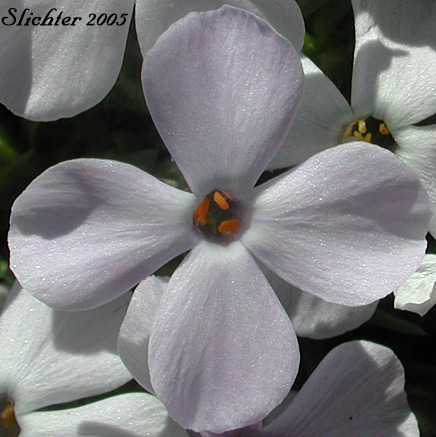 The photo at right shows a flower of spreading phlox with 4 instead of the usual 5 corolla lobes. Photographed along the Highline Trail, above 6000' on the northern side of Mt. Adams.........July 24, 2005.
Characteristics:
Spreading phlox is a beautiful, primarily mat-forming perennial.
It may occasionally be found with upright growth, but not exceeding 10 cm in
height. Its leaves are green, and not sticky or hairy. They tend to be much
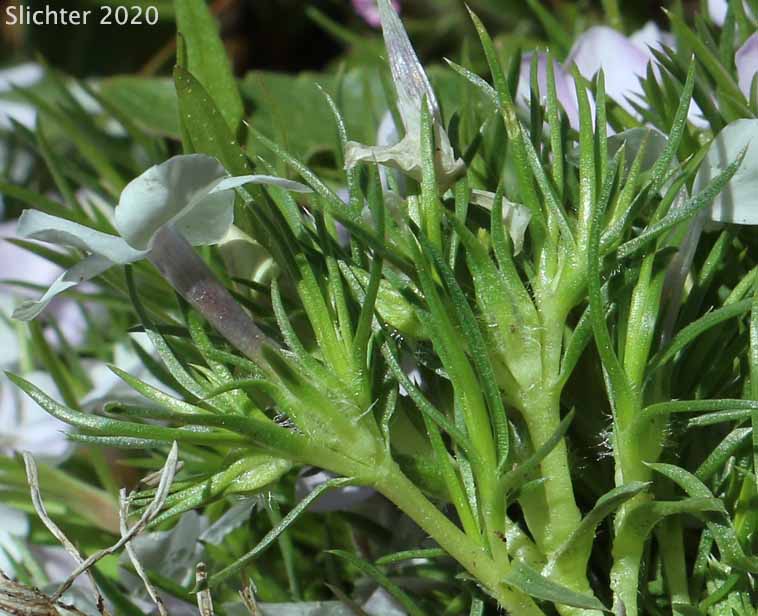
softer to the touch than those of many phloxes. Leaf shape is acicular or needle-like,
with a length of 5 to 20 mm, and a width of 1 to 2 mm.
The flowers are solitary and nearly sessile at the ends of the
stems. The calyx is somewhat hairy, with flat intercostal membranes (between
the ridges). The flowers are tubular, with the 5 petal lobes angled perpendicularly
away from the tube. The tube is about 9-17 mm long, with the lobes being 5 to
9 mm long. Flower color is white, pink, or a light blue.
Habitat:
Spreading phlox is a wildflower of middle to high elevations
in the mountains. It is typically found in open forests or open rocky slopes.
Range:
Spreading phlox is found from the mountains of Vancouver Island,
south through the Olympic Mts, and at Saddle Mt in the coast range of Oregon.
It is widespread through the Cascades from southern British Columbia to the
Sierra Nevada of California. Eastward, it ranges across northern Washington,
Idaho, and Montana to the west slopes of the Rocky Mts. It may occasionally
be found as far south as the mountains of central Idaho and northeastern Oregon.
 -
- 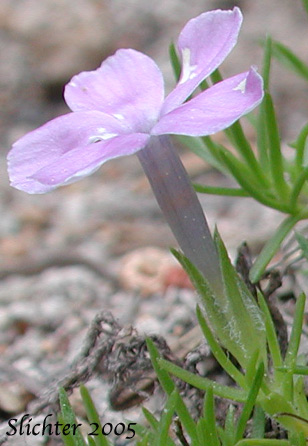
The photo above left shows a close-up sideview of the corolla tube and calyx of spreading phlox as seen along Forest Road #40 near Sunset Point in the Umatilla National Forest of southeastern Washington........June 25, 2007. The photo at right above shows a close-up side-view of the calyx and tubular corolla of spreading phlox. Note the tufts of hairs found between the calyx lobes. Photographed in the summit crater of Potato Hill, on the north side of Mt. Adams.........June 21, 2005.
 -
- 
A nice mat of spreading phlox as seen at left on Wedge Mt., Wenatchee National Forest........June 8, 2009. The photo at right shows spreading phlox atop Spanish Peak, Ochoco National Forest......June 17, 2019.
 -
-  -
- 
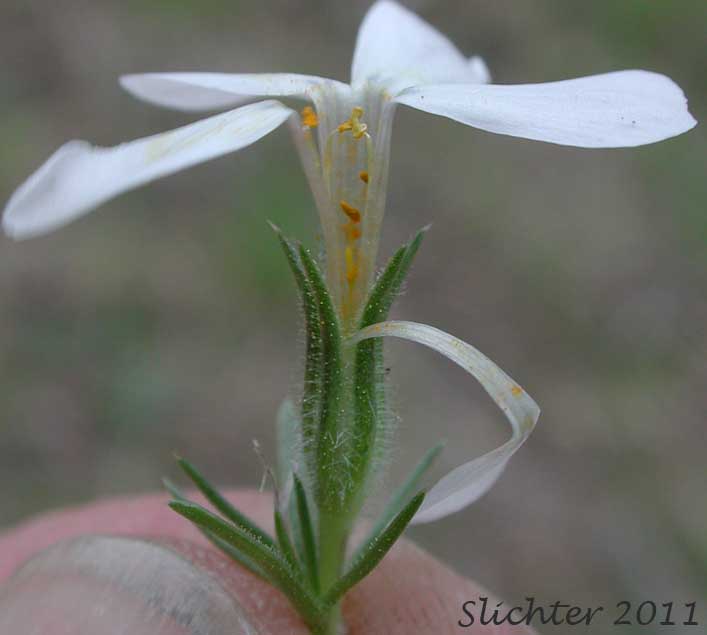
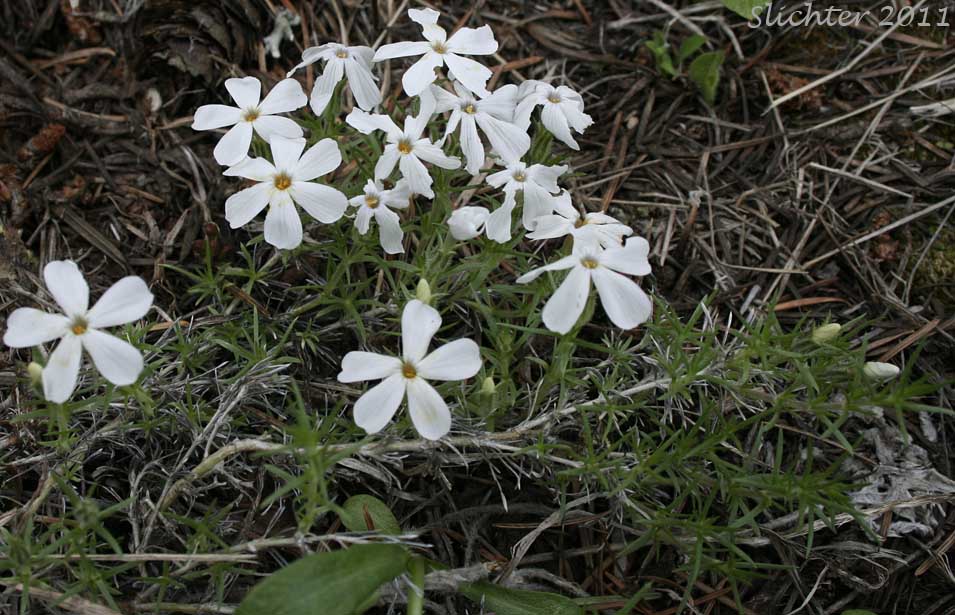
Additional close-ups of spreading phlox as seen on serpentine outcrops along FS Road 5401 downhill from the Malheur National Forest boundary on the north-facing slope of Baldy Mountain..................June 3, 2011.
 -
-  -
- 
 -
- 
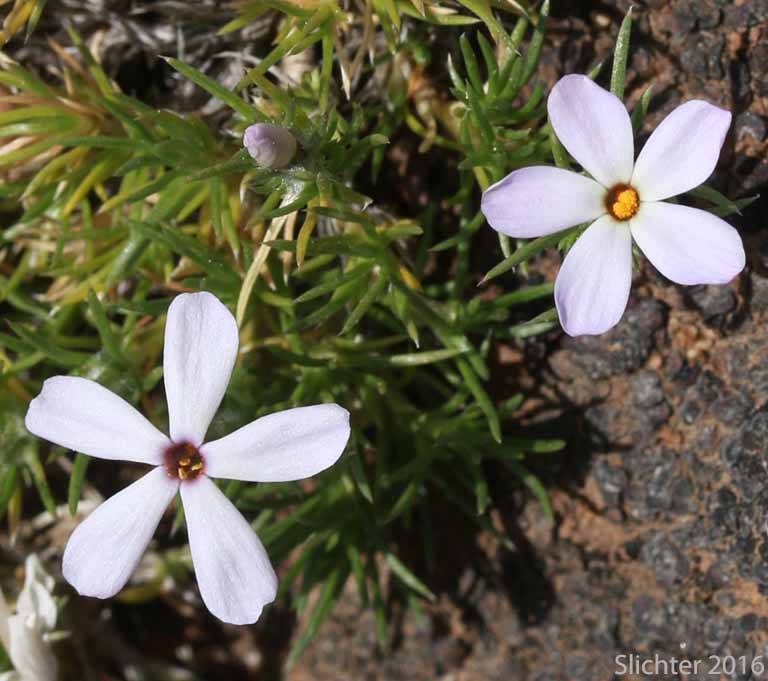
Close-ups of spreading phlox as seen along the valley trail about one-half mile uphill and northwest of the Painted Rocks trailhead, Little Spokane River Natural Area................May 12, 2011.
 -
- 
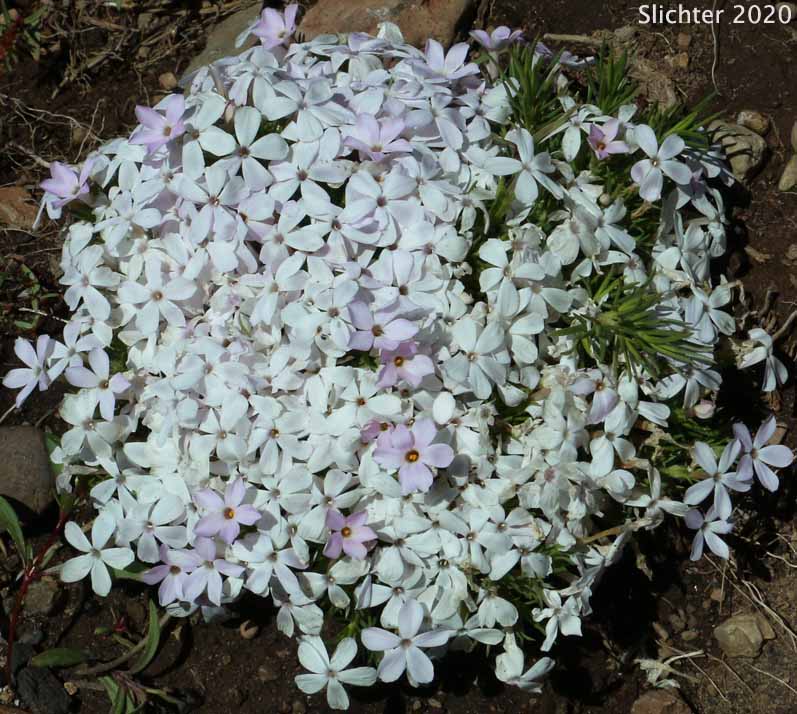
What appears to be diffuse phlox as seen near the crest of the Hart Mt. ridgeline west of Hot Springs Campground, Hart Mt. National Antelope Refuge.........June 9, 2016.
 -
-  -
- 
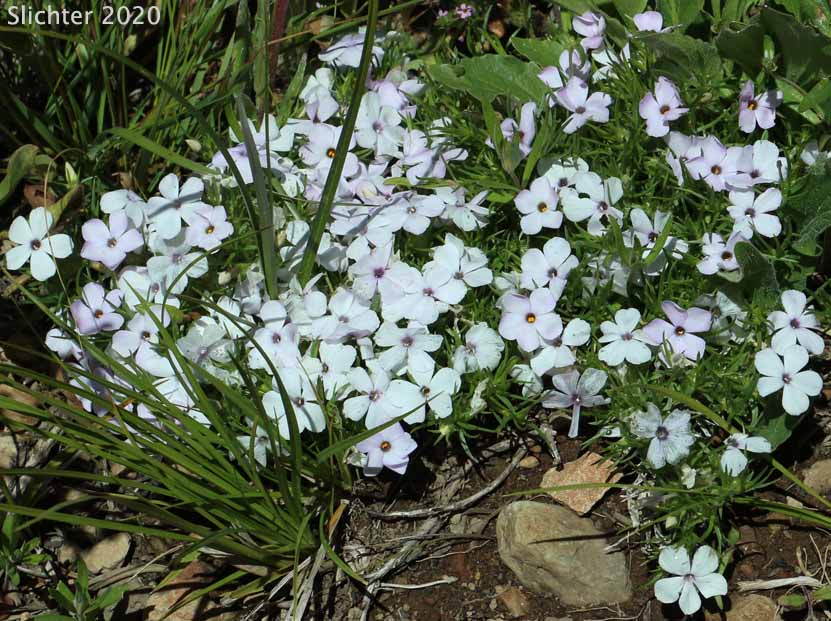
Diffuse phlox observed along the Hanan Trail #142, Fremont-Winema National Forest.......June 17, 2020.
 -
- 
Diffuse phlox blooming along the Fremont National Recreation Trail #160 on the southeastern shoulder of Crook Peak, Fremont-Winema National Forest.....July 17, 2022.

Photo above of spreading phlox from Picture Rock Pass, near Summer Lake, OR....May 25, 1996.
Paul Slichter