[Lupines: The Genus Lupinus East of the Cascade Mts. of Oregon and Washington]
Longspur Lupine, Spur Lupine, Spurred Lupine
Lupinus arbustus
Synonyms: Lupinus amabilis, Lupinus arbustus ssp. arbustus, Lupinus arbustus ssp. arbustus var. arbustus, Lupinus arbustus ssp. arbustus var. montanus, Lupinus arbustus ssp. calcaratus, Lupinus arbustus ssp. neolaxiflorus, Lupinus arbustus ssp. pseudoparviflorus, Lupinus arbustus ssp. silvicola, Lupinus arbustus var. montanus, Lupinus argenteus ssp. argenteus var. laxiflorus, Lupinus argenteus var. laxiflorus, Lupinus caudatus, Lupinus caudatus var. submanes, Lupinus caudatus var. subtenellus, Lupinus laxiflorus, Lupinus laxiflorus ssp. laxiflorus, Lupinus laxiflorus var. calcaratus, Lupinus laxiflorus var. cognatus, Lupinus laxiflorus var. elmerianus, Lupinus laxiflorus var. laxiflorus, Lupinus laxiflorus var. lyleianus, Lupinus laxiflorus var. pseudoparviflorus, Lupinus laxiflorus var. silvicola, Lupinus lyleianus, Lupinus mucronulatus var. umatillensis, Lupinus sulphureus var. applegatianus

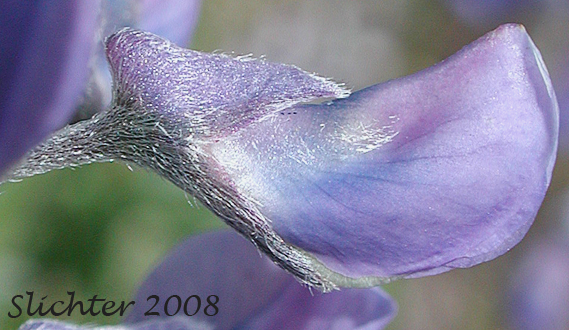
The photo above shows a close-up of the flower of spurred lupine as seen along the Cold Springs Road at Cold Springs Cow Camp in the northern Hells Canyon National Recreation Area........June 26, 2008. Note the spur at the base of the upper calyx lobe as well as the banner, which is directed more forward than erect and held closely towards upper surface of the front of wings. Note also the upper tip of the wings which is pubescent, a characteristic (along with the spur) of note for this species.
 The photo at right shows a close-up of the keel of spurred lupine as seen along Hat Pt. Road in the Hells Canyon National Recreation Area........June 26, 2007.
Characteristics:
Spurred lupine is an attractive perennial wildflower suitable for mountain
or arid climates. Its numerous stems are spreading to erect and are simple to
sparingly branched, ranging from 20-80 cm high. The herbage consists of fine,
appressed hairs which all point in one direction and which give the stems and
leaves greenish-gray to silver-gray appearance. The palmately compound leaves
are primarily found on the stems. The petioles of the lower leaves range from
2-4 times longer than the leaf blades, while the upper petioles are roughly
half as long as the blades. The blades consist of 7-11 narrowly oblong-oblanceolate
to oblong leaflets with the tips ranging from pointed to occasionally obtuse
or rounded. The leaflets range from 3-5 cm long. The herbage of the leaves is
various ranging from pubescent on both surfaces to glabrous above and silvery-haired
below.
The racemes are 7-20 cm long and range from loosely flowered to sometimes fairly
crowded. The flowers range from 9-14 mm long with flower stems from 3-7 mm long.
The calyx has a noticeable sac or spur just above its attachment point to the
flower stem. The spur ranges from 1-3 mm long. The upper lobe of the calyx is
cleft at its tip and is usually less than 1/3 the length of the corolla wings.
The banner is fairly pubescent on its back to above the center. The wings are
minutely hairy on the upper side, just below the banner. The margin of the keel
is fringed by minute hairs most of its length. The flowers vary from blue, pink,
violet, rose and purple to cream or white. The pods are fairly covered with
silky hairs and range from 2-3.5 cm long.
Similar Species:
The taxonomy of the spurred lupines has changed a number of
times over the course of the past 10 years. This list attempts to differentiate
between the spurred lupines, whether they have been lumped into a single unit
as some have suggested or whether they are separate entities.
Spurred lupine is almost indistinguishable from Kellogg's
spurred lupine (Lupinus caudatus). Both are frequently found together
and great care must be taken to not misidentify them. Spurred lupine generally
differs from the latter in having a shorter upper calyx lobe (less than 1/2
the length of the wings of the corolla) and by having minute hairs (You need
a hand lens to see them!) on the upper edge of the wings, just below the banner.
Silvery Lupine: Lupinus argenteus var. heteranthus
- Back of banner sparsely hairy or glabrous.
When present, hairs may be largely hidden by the upper calyx lip. Flowers 5-10
mm long with the banner index from 4-9. Wing petals
not pubescent near the tip, although sometimes hairs may be present
along the midvein. Basal leaves generally absent when
in bloom, but if present, the pedicels are less than three times
as long as the leaflets. Found from Lake County in south-central Oregon and
the Steens Mt. of southeastern Oregon and south to Mono county in California
and east to western Nevada.
Kellogg's Spurred Lupine: Lupinus caudatus (now L.
argenteus var. heteranthus ?) - Back of banner typically pubescent
on lower 2/3 of banner. Flowers 10-12 mm long, the banner index measuring
from 5-10. Wing petals not pubescent near tip.
Upper calyx lip nearly as long as the lower lip, measuring
1/3-3/4 as long as the wings. Found
east of the Cascade Mts. from central Oregon south to California and east through
Idaho to Montana and Colorado.
Spurred Lupine: Lupinus laxiflorus (now L. arbustus) - Back
of banner typically pubescent on lower 2/3 of banner. Flowers 9-14
mm long, the banner index from 4-9. Wing petals pubescent
near tip. Upper calyx lip much shorter than the lower lip, only 1/5-1/4
as long as the wings. Found in and to the east of the Cascade Mts. from central
Washington south through Oregon to California and east to Idaho, Utah and Nevada.
Sulphur Lupine: Lupinus sulphureus - Back
of banner glabrous or sparsely pubescent, especially under the upper calyx lip.
Typically not spurred, but if spurred, the spur is short. Flowers 9-12 mm long,
the banner index from 4-10. Basal leaves generally present while in bloom with
pedicels 3-5 times longer than the leaflets. Found east and west of the Cascade
Mts. from south-central British Columbia south through central Washington and
Oregon to California and east to Idaho.
Habitat:
East of the Cascade Mts, spurred lupine may commonly be found
in sagebrush or ponderosa pine habitats. In the Cascades, it may be found in
coniferous forests including Douglas fir.
Range:
Spurred lupine is primarily found east of the Cascade Mts. from
Washington east to Idaho and Montana, and south to California, Utah and Nevada.
Variety laxiflorus is found in the western portion of the range of the
species.
 -
- 
The photo at left shows spurred lupine as seen along the Cold Springs Road at Cold Springs Cow Camp in the northern Hells Canyon National Recreation Area.........June 26, 2008. The photo at right shows both a cream-colored and normal flowered form of spurred lupine as seen along Observatory Road on DNR lands on the south side of Manastash Ridge, Yakima County, WA......May 27, 2019.
 -
- 
 -
- 
The 4 photos directly above show close-up views of the flower and leaflets of spurred lupine as seen along the Cold Springs Road at Cold Springs Cow Camp in the northern Hells Canyon National Recreation Area.........June 26, 2008. Note the hairs on the back of the banner just forward of the upper calyx lobe in the photo at upper right. Note the greenish, less hairy upper surface of the leaflet in the photo at lower left, while the photo at lower right shows the more heavily hairy lower surface of a leaflet. Click each photo to see enlarged views.

The photo above shows a close-up of the flower of spurred lupine as seen along Hat Pt. Road in the Hells Canyon National Recreation Area.......June 26, 2007. Note the spur at the base of the upper calyx lobe as well as the banner, which is directed more forward than erect and held closely towards upper surface of the front of wings.
 -
- 
Close-up images of the spur and irregular calyx and leaflets of spurred lupine as seen along Oregon Highway 206 near the Mt. Viewpoint to the east of the John Day River..........May 28, 2007. The upper lobe of the calyx is broader and shorter than the longer, lower lobe. The leaflets of this species are quite long and narrow.
 -
- 
The photo at left shows the raceme of spurred lupine as seen along Hat Pt. Road in the Hells Canyon National Recreation Area.......June 26, 2007. The photo at right shows spurred lupine as seen at the trailhead for a jeep road extending north of the Box Canyon Road in the Simcoe Mountins Unit of the Klickitat Wildlife Area......My 10, 2021. This trailhead is about one-quarter of a mile west of the gate at the end of Box Canyon Road.

The photo above shows spurred lupine as seen along Oregon Highway 206 near the Mt. Viewpoint to the east of the John Day River..........May 28, 2007.
 -
- 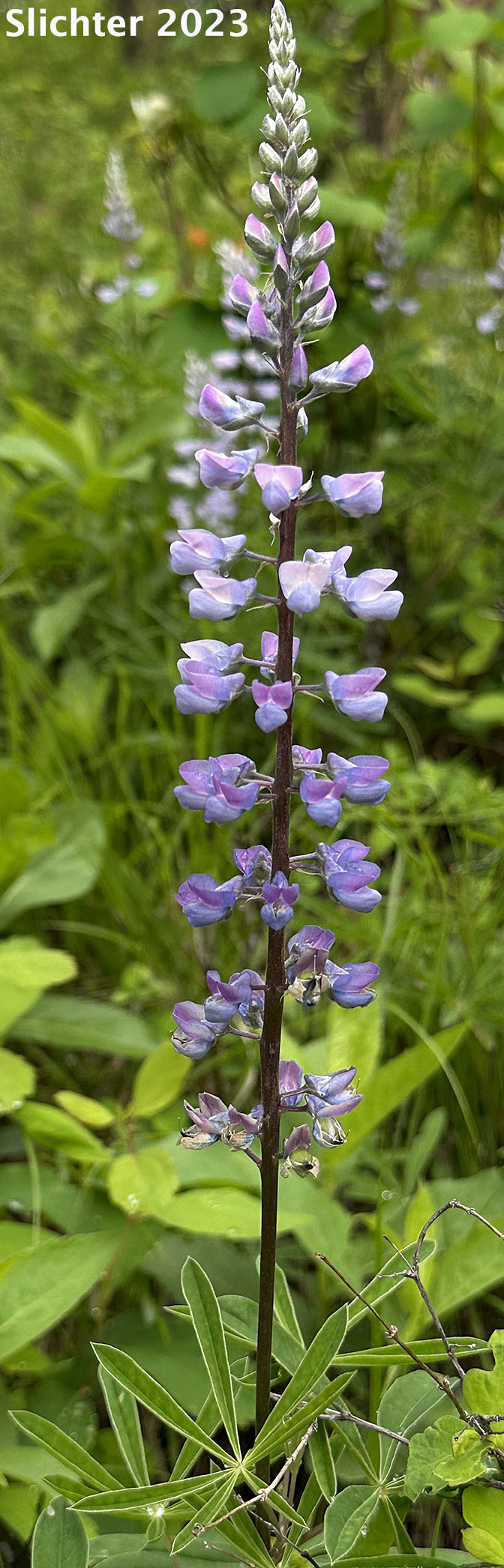
Longspur lupine blooming at left with shrubby penstemon and sticky gooseberry on Wedge Mountain, Wenatchee National Forest.........June 8, 2009. The photo at right shows spurred lupine blooming along the Holland Falls National Recreation Trail #416, Flathead National Forest......May 27, 2023.
 -
-  -
-
Close-up views of the flower, raceme and palmately compound leaf of longspur lupine as seen on Wedge Mountain, Wenatchee National Forest.........June 8, 2009.
 -
-  -
- 
 -
- 
 -
- 
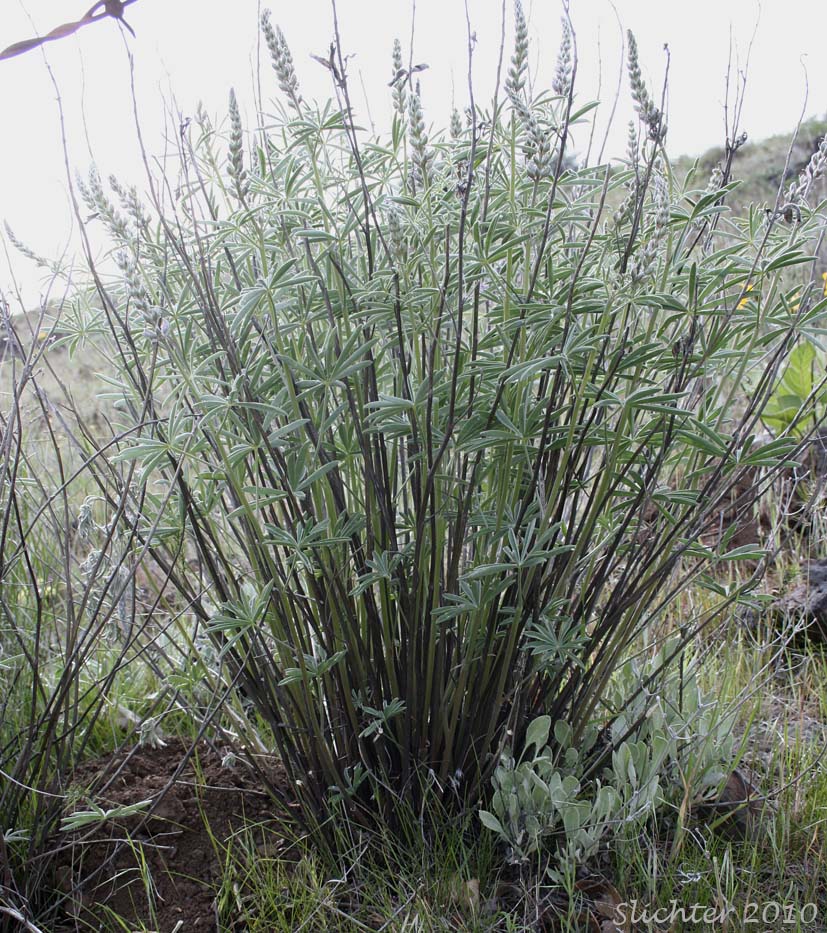
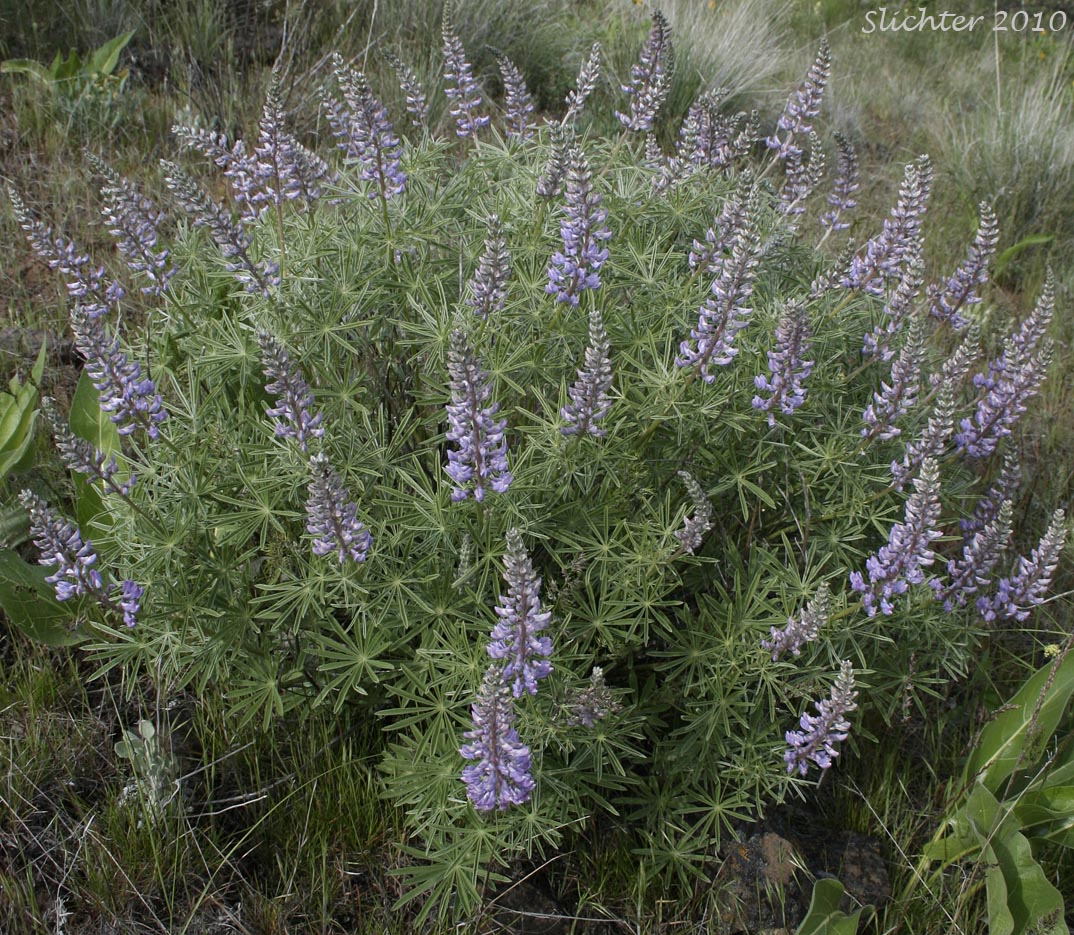
Close-up details of spurred lupine as seen along the Bickleton Highway where it descends the eastern slopes of Rock Creek, Klickitat County.........April 18, 2010. Note the minute whitish hairs on the lower back of the banner (forward of the calyx) and on the upper tips of the wing petals.
 -
- 
 -
-  -
- 
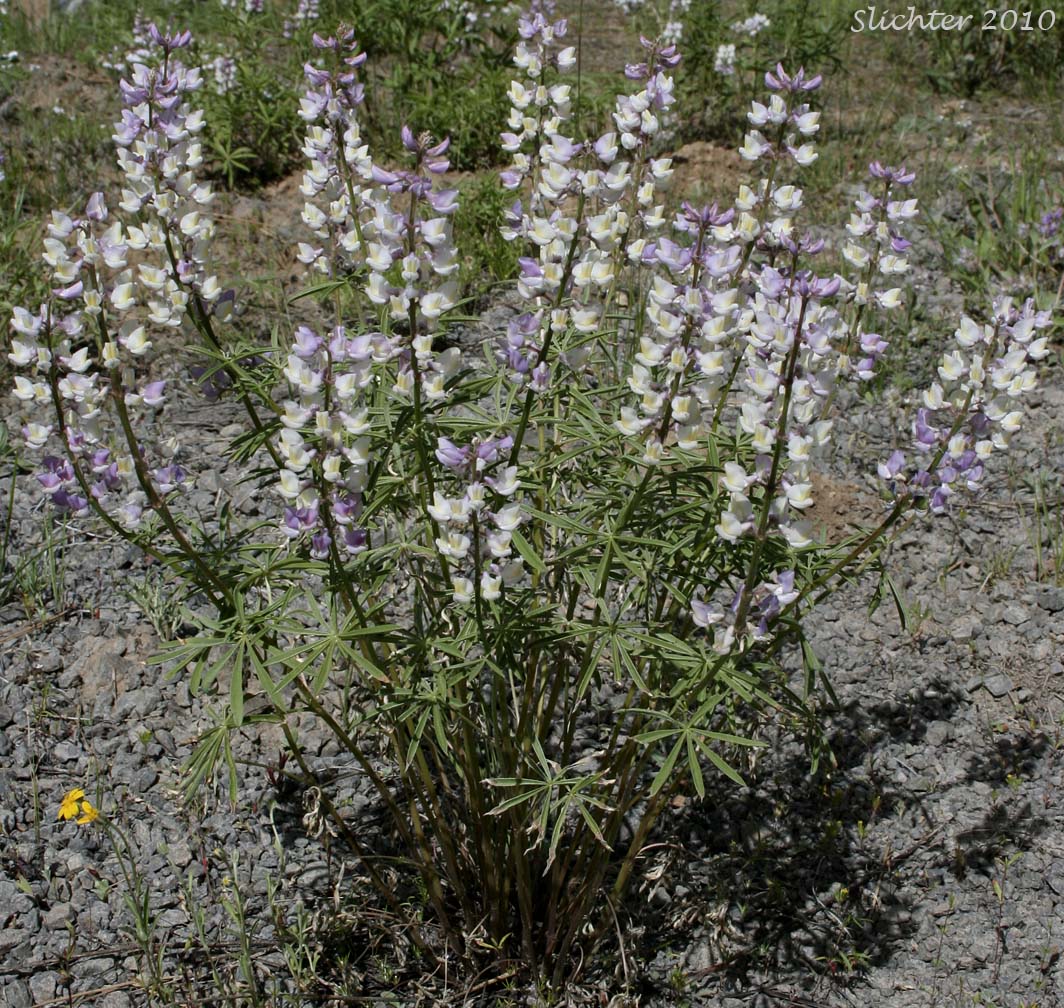
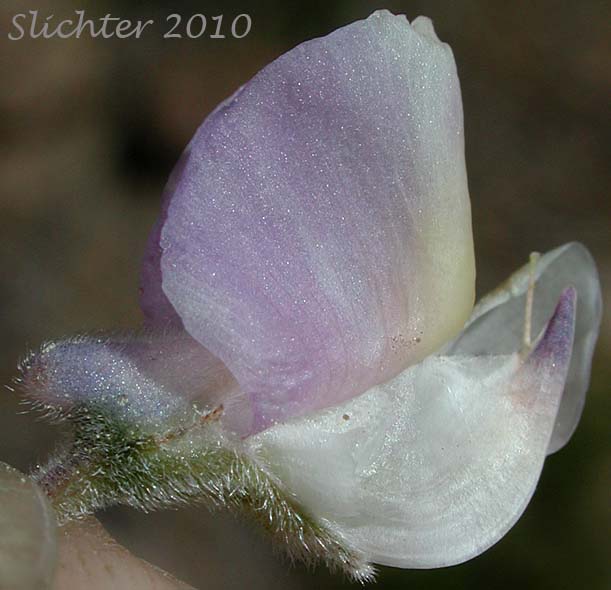
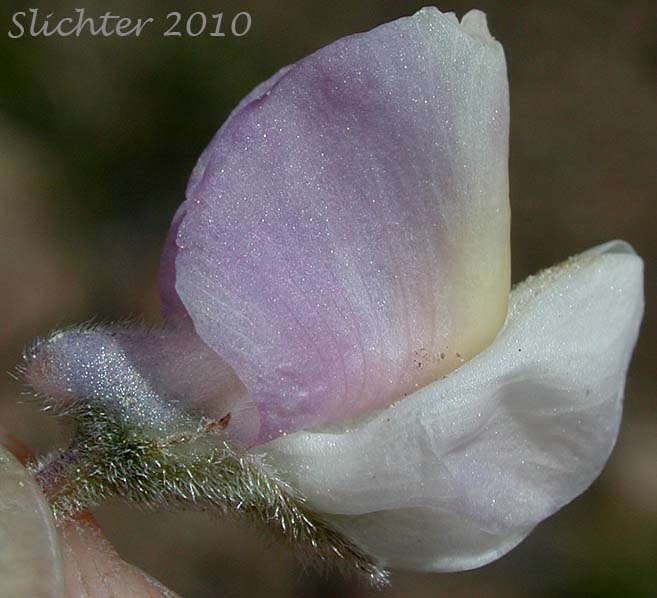
Close-up photos of spurred lupine (former ssp. calcaratus) as seen along Forest Service Road #1450 in the Malheur National Forest.........July 3, 2010.
 -
- 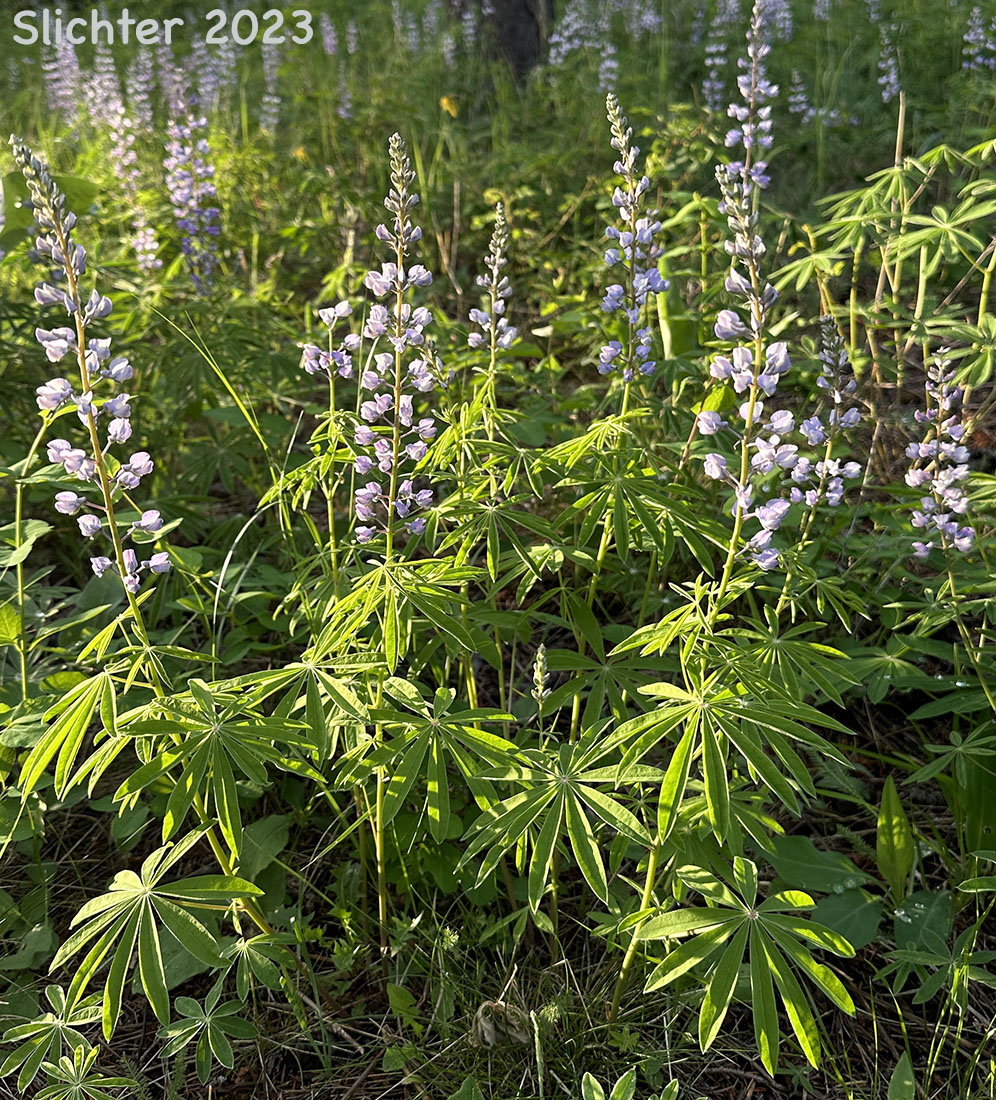
Spurred lupine as seen at left from Antelope Mountain Lookout, Malheur National Forest.........June 25, 2011. The photo at right shows spurred lupine blooming on slopes uphill to the east of Woods Bay, Montana......May 26, 2023.
 -
- 
Spurred lupine blooming at about 7600' between Table Rock and Bullrun Rock in the Monument Rock Wilderness.........August 3, 2011.
 -
- 
Spurred lupine beginning to bloom in the Umatilla National Forest at Bald Mountain several miles to the east of Tollgate, Oregon........July 1, 2012.

A white-flowered form of spurred lupine as seen along Colockum Pass Road, Wenatchee Mountains........July 7, 2012.
 -
-  -
- 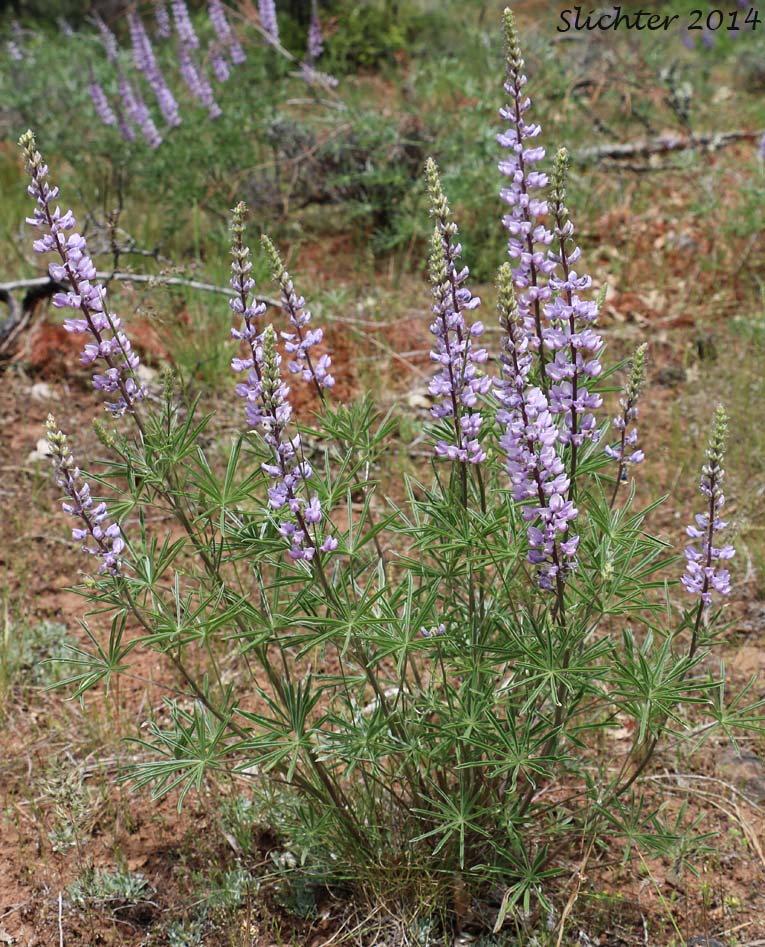
Spurred lupine as seen at Brooks Memorial State Park near Satus Pass, Washington............May 19, 2014.
 -
- 
Spurred lupine as seen along Oregon Highway 86 south of Pine, Baker County, Oregon........June 11, 2018.
 -
-  -
- 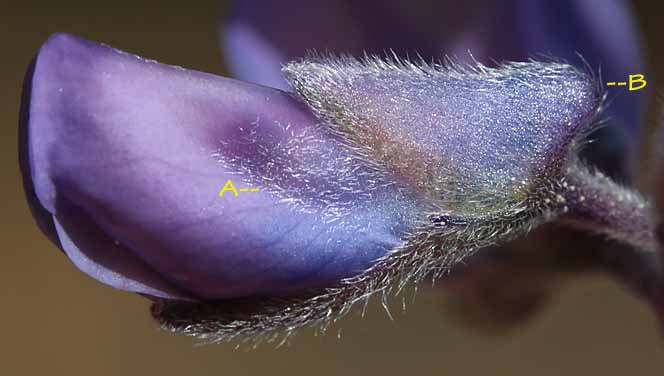
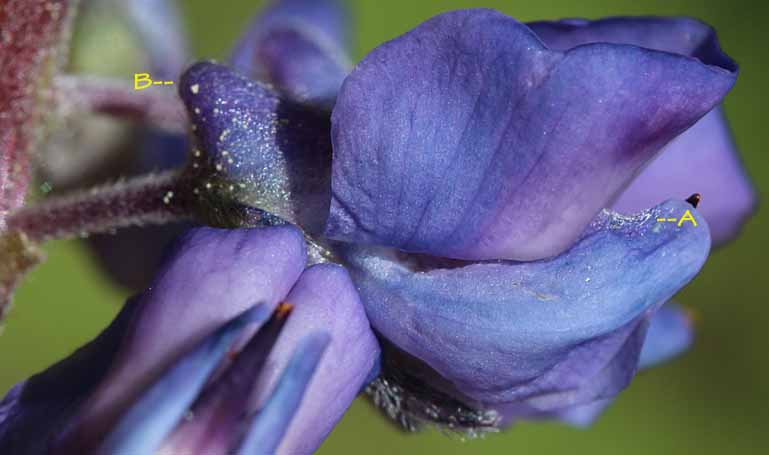
A spurred lupine beginning to bloom atop a high bluff above the North Fork Catherine Creek about a mile south of Catherine Creek Meadows, North Fork Catherine Creek Trail #1905, Eagle Cap Wilderness......June 12, 2018. In the photo at right, note the prominent spur at the base of the calyx at B and the minute hairs atop the tip of the wing petals at A. In the photo at right, note the prominent spur at the posterior end of the calyx at B and the numerous hairs on the lower third of the back of the banner at A.
-
Longspur lupine beginning to bloom at the Hells Canyon Scenic Overlook, Hells Canyon National Recreation Area.......June 11, 2018. Note the spur at the base of the calyx (A) and the minute hairsatop the tip of the wing petals (B).
Paul Slichter