
 Photo at right of Camassia
quamash ssp. breviflora at Jackman Park C.G., the Steens Mt....8/3/95.
Photo at right of Camassia
quamash ssp. breviflora at Jackman Park C.G., the Steens Mt....8/3/95.
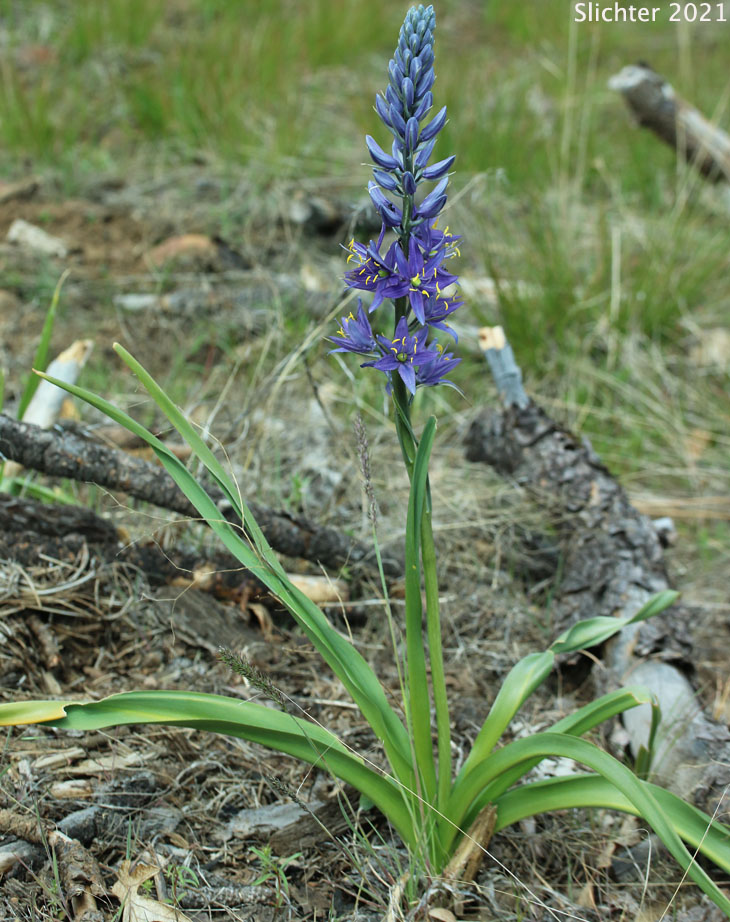
Common Camas consists of a stout stem arising 20 to 70 cm from a large bulb. The ovoid bulb may be 2 to 5 cm long and 1 to 2.5 cm wide. The leaves are primarily basal, and are about half as long as the height of the stem, and may be 8 to 25 mm wide. They are linear in shape with parallel venation.
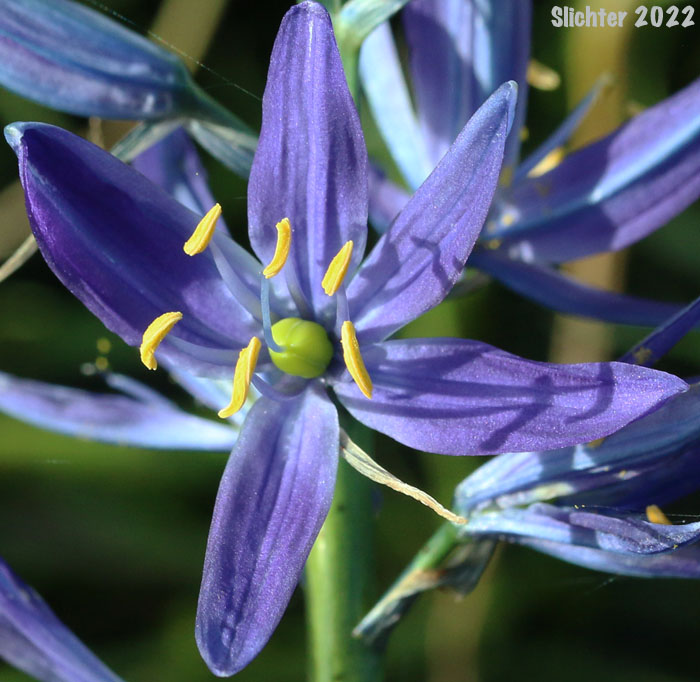
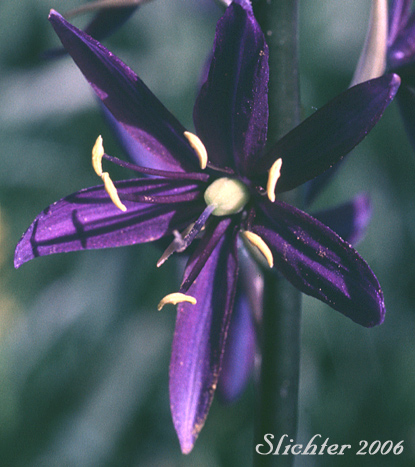
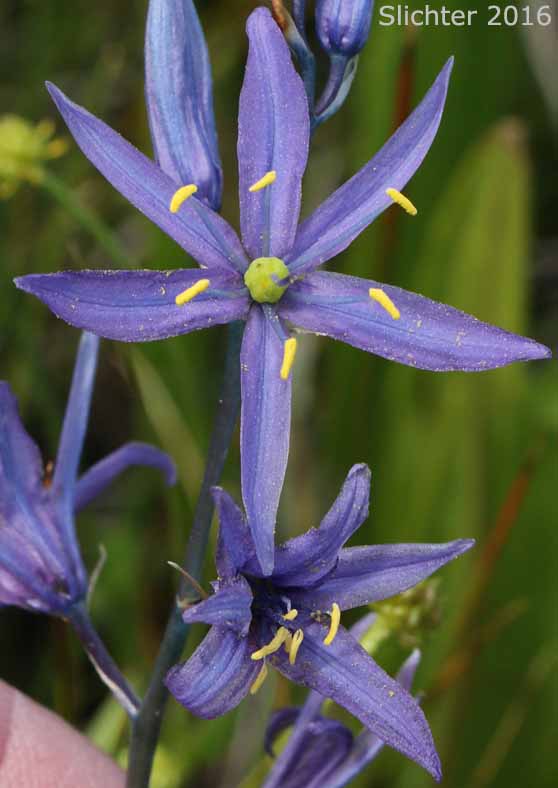
The inflorescence is an elongated raceme of closely to loosely spaced flowers. Individual flowers are pale to deep blue or violet colored. White (albino) individuals are possible. The tepals are narrowly elliptical in shape, 15 to 35 mm long and 2 to 8 mm wide. The six stamens have yellow to blue anthers, depending upon the variety.
Common Camas was a valuable food source for the native peoples of the Pacific Northwest. Today, its importance is as meadow wildflower in gardens. It is expecially effective grown in dense drifts. It self seeds readily, and care must be taken not to accidentally weed out the seedlings. Several years must pass before the seedlings are ready to flower, which is the case for most members of the lily family.
ssp. breviflora - Widespread distribution across central and eastern Oregon and Washington.
ssp. quamash - Found across north-central and northeastern Oregon and much of Washington east of the Cascades.
ssp. utahensis - Found across eastern Oregon near the Idaho border.
ssp. walpolei - Found across central and southern Klamath and Lake Counties in Oregon.
Common camas lives in grassy areas which are moist in the spring and which dry up during the summer and fall.
Common camas is a widespread wildflower found from southern British Columbia along both sides of the Cascades south to California. Eastward, its range extends to southwest Alberta, Montana, Wyoming, and Utah.
 -
- 

 -
-  -
- 
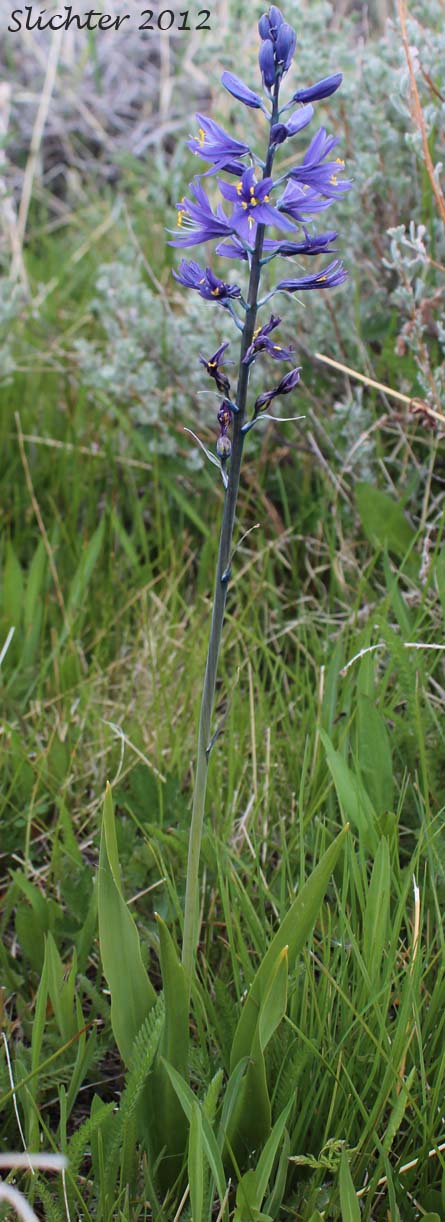
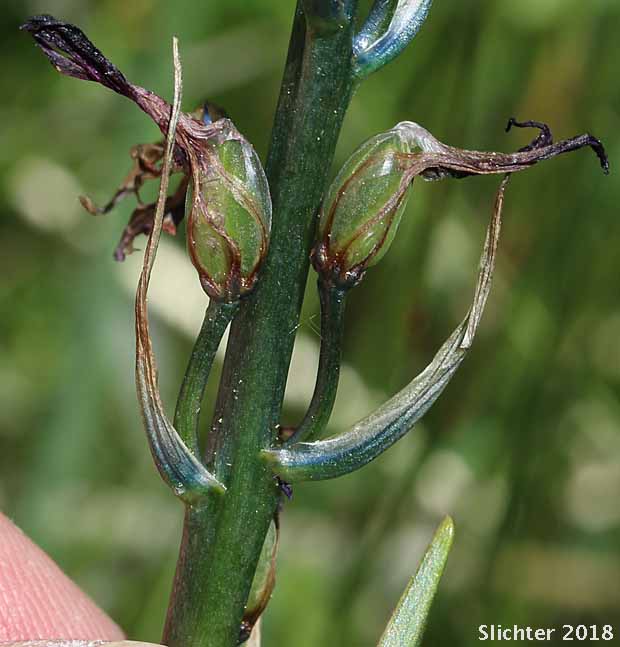
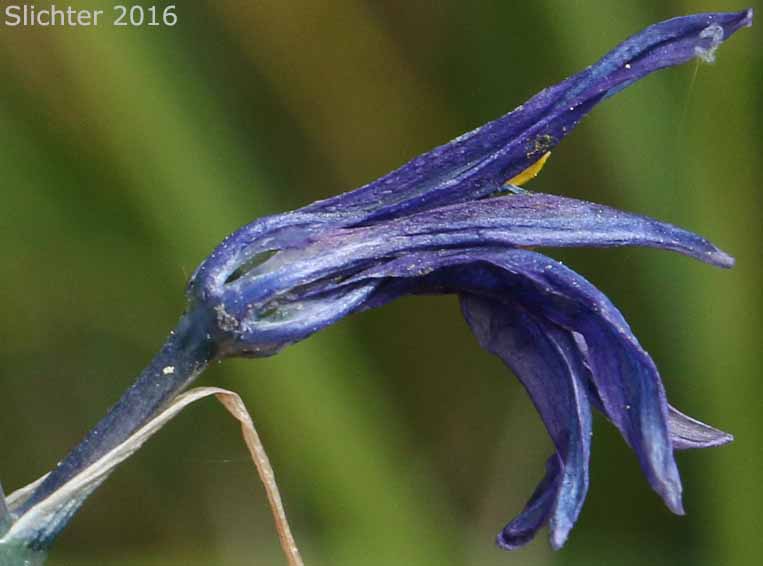
Common camas blooming at left in a vernally moist wetland (amongst sagebrush, Aretemisia tridentata) at the head of a south branch of Little Cottonwood Creek just west of a pass along Arizona Creek Road in the Pueblo Mountains of southeastern Oregon.............June 1, 2012. Note the twisted, withering tepals, a characterisitc of ssp. breviflora. The withering tepals of ssp. guamash, which can also be in southeastern Oregon, do not twist over each other.
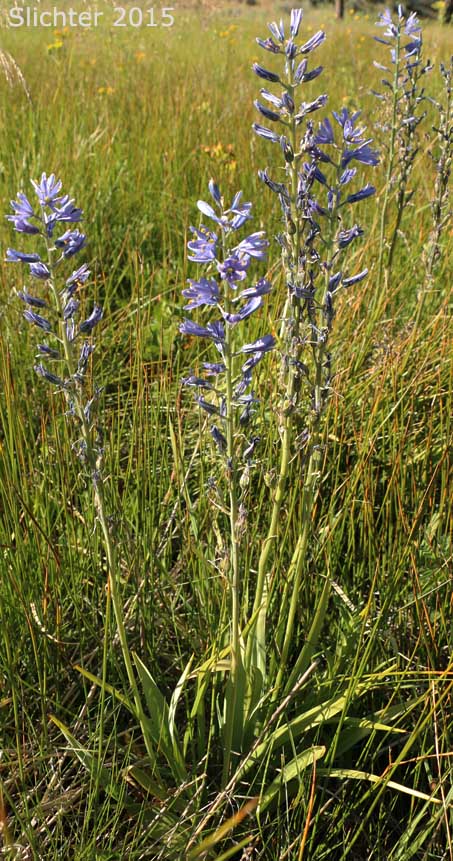
The photo at center shows common camas as seen in a vernally moist swale along the Steens Mountain North Loop Road at a point where the juniper forest abruptly transitions to sagebrush steppe.............June 2, 2012. The site is on the south side of the road just above a gate where there is also a stock pond.
The photo at right shows a close-up of the inflorescence of common camas as seen along Road #46 at Dougherty Springs in the northern Wallowa-Whitman N.F........June 26, 2008.
 -
-  -
- 
 -
- 
 -
- 
 -
-  -
-  -
- 
 -
- 
 -
- 
 -
-  -
- 
 -
-  -
- 

 -
- 
 -
- 
 -
-  -
- 
 -
- 


